Drone Service Market
Visiongain has published a new report entitled Drone Service Market Report 2026-2036 (Including Impact of U.S. Trade Tariffs): Forecasts by Solution (End-to-End Solution, Point Solution), by Customer Type (Government Agencies, Businesses & Enterprises, Other), by Service Type (Drone Rental, Drone Sales, Drone Pilot Training, Other), by Application (Filming & Photography, Mapping & Surveying, Inspection & Monitoring, Delivery & Logistics, Other), by Industry Vertical (Construction & Infrastructure, Agriculture, Logistics & Transportation, Defence & Law Enforcement, Media & Entertainment, Other) AND Regional and Leading National Market Analysis PLUS Analysis of Leading Companies.
The global drone service market is estimated at US$35,727.4 million in 2026 and is projected to grow at a CAGR of 27.8% during the forecast period 2026-2036.
Impact of US Trade Tariffs on the Global Drone Service Market
The imposition of U.S. tariffs on drone imports particularly from key manufacturing hubs like China has introduced both challenges and opportunities in the global drone service market. These tariffs, which target components such as sensors, batteries, control systems, and finished drones, have led to higher production costs and delayed supply chains for U.S.-based drone service providers. The trade tensions have particularly affected commercial operators and startups that rely heavily on Chinese-manufactured drones and spare parts. However, the situation has also catalysed the growth of domestic manufacturing ecosystems in the U.S., as companies increasingly invest in local production and research to mitigate import dependency. The global market is witnessing realignment as Europe, Japan, and India expand their manufacturing and export capacities to fill supply gaps created by U.S.–China trade frictions.
In addition, the tariffs have influenced pricing structures and procurement decisions across end-user industries. Sectors such as agriculture, logistics, and energy have faced temporary disruptions in drone service contracts due to cost inflation and component shortages. Nonetheless, policy support from U.S. agencies like the FAA and Department of Defense for homegrown manufacturers (e.g., Skydio, ModalAI, and Shield AI) has bolstered the resilience of the North American drone ecosystem. This evolving tariff landscape has, therefore, created a two-fold impact: short-term constraints in supply and costs, and long-term incentives for technological innovation, reshoring, and diversification in the global drone service supply chain
Direct-To-Consumer Logistics Is Converting Hype Into Users
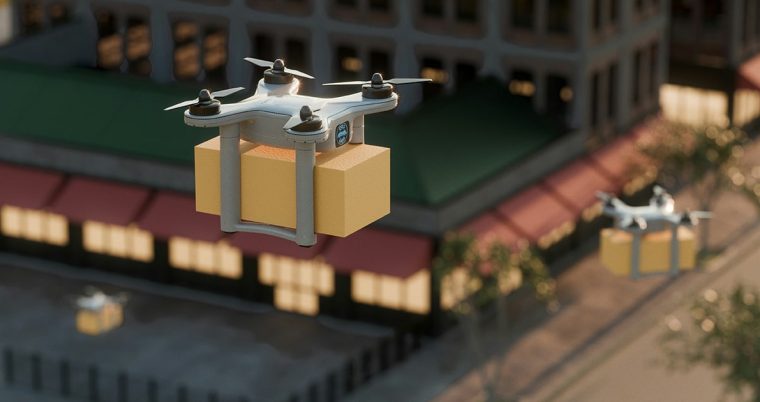
Retail and healthcare use-cases have crossed the pilot chasm. Alphabet’s Wing and Walmart announced what they called the world’s largest drone-delivery expansion in June 2025—rolling out to 100 additional Supercenters across Atlanta, Charlotte, Houston, Orlando, and Tampa—on top of earlier Dallas–Fort Worth operations. Walmart’s framing of drones as a mainstream, 20-minute delivery option, with autoloader stations and six-mile BVLOS routes, demonstrates mature operations and a clear playbook for store-anchored networks. That matters because large retailers pull through the ecosystem: once drones are normalized in grocery and general merchandise, adjacent categories (pharmacy, QSR, electronics) typically follow.
Healthcare is following a similarly durable path. Zipline has additive U.S. approvals after its Part 135 certification and 2023 BVLOS authorization, and it continues to sign recognizable partners—from Cleveland Clinic’s prescription deliveries to national restaurant and health-system brands—around its quieter, precise P2 Zip platform. Meanwhile, Amazon’s Prime Air is expanding footprints outside the U.S., with successful tests in Italy in December 2024 and a planned service launch as national regulators finalize requirements. The competitive signal is unambiguous: major logistics brands are treating drones as a coverage and CX lever rather than a novelty, which catalyses investment in hubs, software, and aircraft reliability that drone service providers can ride.
How will this Report Benefit you?
Visiongain’s 413-page report provides 126 tables and 190 charts/graphs. Our new study is suitable for anyone requiring commercial, in-depth analyses for the drone service market, along with detailed segment analysis in the market. Our new study will help you evaluate the overall global and regional market for drone service. Get financial analysis of the overall market and different segments including solution, customer type, service type, application and industry vertical, and capture higher market share. We believe that there are strong opportunities in this fast-growing drone service market. See how to use the existing and upcoming opportunities in this market to gain revenue benefits in the near future. Moreover, the report will help you to improve your strategic decision-making, allowing you to frame growth strategies, reinforce the analysis of other market players, and maximise the productivity of the company.
What are the Current Market Drivers?
‘Drone-In-A-Box’ Automation and Multi-Drone Control Cut Operating Cost
Autonomy is rewriting the cost structure. Fully remote ‘drone-in-a-box” systems from Percepto and DJI eliminate many truck rolls and on-site pilots, converting inspection and security missions into scheduled, repeatable tasks. Percepto’s nationwide, shielded-BVLOS waiver and its later approval to operate up to 30 autonomous aircraft per single operator have given industrial sites a credible path to 24/7, remote-first operations, while DJI’s Dock 2 (and 2025 Dock 3 evolution) show a steady cadence of more rugged, mobile, and easier-to-permit stations geared for utilities, campuses, and public-safety nodes. These platforms are also shipping with enterprise software (e.g., FlightHub 2) that integrates mission planning, data management, and compliance—critical for rolling out fleets across many sites.
Regulators are beginning to bless higher levels of autonomy, which tightens the business case. In January 2025, vHive secured an FAA authorization for autonomous multi-drone operations at U.S. solar farms—bringing swarm-style workflows from research into production—and U.S. utilities like AEP and PG&E have documented waivers enabling fully remote, docked inspections at distribution and substation sites. As multi-drone scheduling, detect-and-avoid and remote-ID telemetry become table stakes, service providers can quote lower per-mile and per-asset rates with better uptime SLAs, expanding the addressable market beyond high-margin early adopters.
Agricultural Modernization Is Now Policy-Backed and at Scale
Agriculture has quietly become the largest, most reliable source of drone flight hours. DJI reports roughly 400,000 agricultural drones in use by the end of 2024—up ~90% from 2020—with adoption credited to clearer pilot-training standards and friendlier spraying regulations across multiple countries. Case studies cite hundreds of supported crops and significant water savings, while new airframes (e.g., Agras) improve anti-drift performance and safety. For drone service firms, this translates into steady seasonal demand for spraying, seeding and scouting, with repeat customer relationships and predictable utilization that smooth the volatility of industrial projects.
Public programs are providing structural demand. India’s ‘Namo Drone Didi” scheme earmarks ~15,000 drones for women-led self-help groups through 2026, bundling capital subsidies, training, and operating models to deliver spraying as a service to smallholder farmers. Press and government updates throughout 2025 highlight pilots, subsidies and trained ‘Drone Didis,’ expanding across states—signaling that agricultural drone services are not just a technology story but a rural employment and productivity policy. For global service providers, these programs create large, funded pools of end users who can be equipped and supported with maintenance, training, and analytics subscriptions.
Where are the Market Opportunities?
Carrier-Grade Retail and Pharmacy Delivery at National Retailers
The most visible near-term revenue is retail and pharmacy delivery anchored by big-box partners. Wing and Walmart’s 2025 expansion demonstrates a repeatable template: multi-store clusters, six-mile radii, curated catalogs and autoloader logistics that minimize store-side friction. Drone service providers can position as ‘white-label aerial last mile” offering SLAs, analytics, and regulatory ops, while retailers fund the network to protect NPS and delivery cost. Over time, SKU expansion and tighter app integrations raise order-density and attachment.
Healthcare magnifies the ROI through time-critical and high-value items. Zipline’s U.S. BVLOS approvals and partnerships (e.g., Cleveland Clinic) enable same-day prescriptions, lab samples and medical devices, with measurable patient-experience gains. With FAA Part 135 experience and documented safety cases, medical networks can scale to metro-wide coverage with fewer pilots and less ground staff than couriers—an advantage in tight labour markets.
Industrial Autonomy ‘As A Service” with Docks and Multi-Drone Ops
Factories, refineries, mines and solar farms are ripe for subscription models: fixed monthly fees for perimeter patrols, thermography, inventory counts and emergency response, all from docked systems monitored by a remote operations centre. Percepto’s approvals for shielded BVLOS and fleet control, plus new FAA authorizations for multi-drone operations at solar sites, give legal and operational cover to price and deliver these services nationally. The win for customers is fewer confined-space entries and line shutdowns; the win for providers is high utilization, predictable MRR and cross-sell into analytics.
Easier-to-deploy docks expand the addressable set. DJI’s Dock 2 and Dock 3 add mobility and environmental resilience (and, in Dock 3’s case, launch-from-vehicle capability), allowing public-safety agencies and utilities to stand up temporary or roaming bases for events, storms or construction seasons. This enables ‘pop-up” service contracts and regional coverage without permanent civil works.
Competitive Landscape
The major players operating in the drone service market are AeroVironment, Inc., AgEagle Aerial Systems Inc., Airbus SE, AIRO Group Holdings Inc., Cyberhawk Innovations Limited, DroneDeploy, DroneShield Ltd, Edall Systems, Garuda Aerospace Private Limited, Percepto Ltd., Phoenix LiDAR Systems, Sky-Futures Ltd, Skyports Drone Services Ltd, Terra Drone Corporation, Zipline International Inc. These major players operating in this market have adopted various strategies comprising M&A, collaborations, investment in R&D, regional business expansion, partnerships, and new product launch.
Recent Developments
- 31-Oct-25, AeroVironment partnered with OpenJAUS LLC to integrate the JAUS standard into the AV_Halo Command platform, enabling seamless interoperability across uncrewed systems (UxS). The integration of OpenJAUS middleware and AV’s modular APIs supports faster, standardized control and integration of JAUS-compliant platforms for OEMs and defense clients.
- 23-Oct-25, Terra Drone entered a strategic partnership with Importadora Lillo SpA / Heliboss Chile to distribute its in-house developed ‘Terra Xross 1” drone across Latin America. The agreement marks the company’s entry into the Chilean market, enhancing global reach. The ‘Terra Xross 1” offers stable indoor flight and costs about one-third of competing models, improving affordability and safety for inspection operations.
- 16-Oct-25, AIRO and Bullet (Ukraine) agree on a 50/50 JV to manufacture and deploy Bullet’s 300 mph interceptor drones for U.S., NATO, and Ukraine defense markets. Drone features include 300 mph speed, 200 km range, and 2.5–9 kg payload. Aligns with U.S. policies supporting domestic drone production.
- 15-Oct-25, Germany’s first long-range drone delivery to offshore wind turbines at Arkona Windfarm. Skyports, RWE, and Skyways conducted ~80 km round-trip BVLOS flights carrying up to 10 kg cargo. Demonstrated improved logistics flexibility, reduced delivery time (sub-30 minutes vs. 1+ hour by boat), using Skyways V2 hybrid long-range drone (range up to 770 km).
- 02-Oct-25, Terra Drone’s subsidiary Unifly joined a European Defence Agency (EDA)-led project to standardize pre-flight risk assessment for drones in defense and security operations. The initiative promotes harmonized operational safety, interoperability, and efficiency across European UAS frameworks, strengthening Terra Drone’s role in defense-grade UTM solutions.
Notes for Editors
If you are interested in a more detailed overview of this report, please send an e-mail to contactus@visiongain.com or call +44 207 336 6100.
About Visiongain
Visiongain is one of the fastest-growing and most innovative independent media companies in Europe. Based in London, UK, Visiongain produces a host of business-to-business reports focusing on the automotive, aviation, chemicals, cyber, defence, energy, food & drink, materials, packaging, pharmaceutical and utilities sectors.
Visiongain publishes reports produced by analysts who are qualified experts in their field. Visiongain has firmly established itself as the first port of call for the business professional who needs independent, high-quality, original material to rely and depend on.
