AI at the Helm: How Generative & Agentic AI Are Reshaping Drug Discovery

The Race Is On: AI as a Core Innovation Engine
What began as basic machine learning for drug screening has now evolved into a multimodal, AI-led ecosystem spanning discovery, development, and clinical decision-making.
AI is now transforming drug development through:
- Accelerating diagnosis and personalised treatment selection
- Designing novel molecules with optimised safety profiles
- Predicting toxicity and ADME to reduce early-stage attrition
- Enhancing trial design through adaptive, data-driven modelling
- Enabling real-time patient monitoring and dynamic dosing strategies
Generative AI, once a niche tool, is now a pipeline driver. Agentic AI is stepping into decision-making roles that cross-functional teams have traditionally held.
- $45B invested globally in AI pharma (Visiongain Intelligence Centre, 2025)
- AI-designed assets in Phase II validation
- Agentic AI platforms are making autonomous R&D decisions
Estimated Investments in Agentic AI by Pharma (2020-2030)
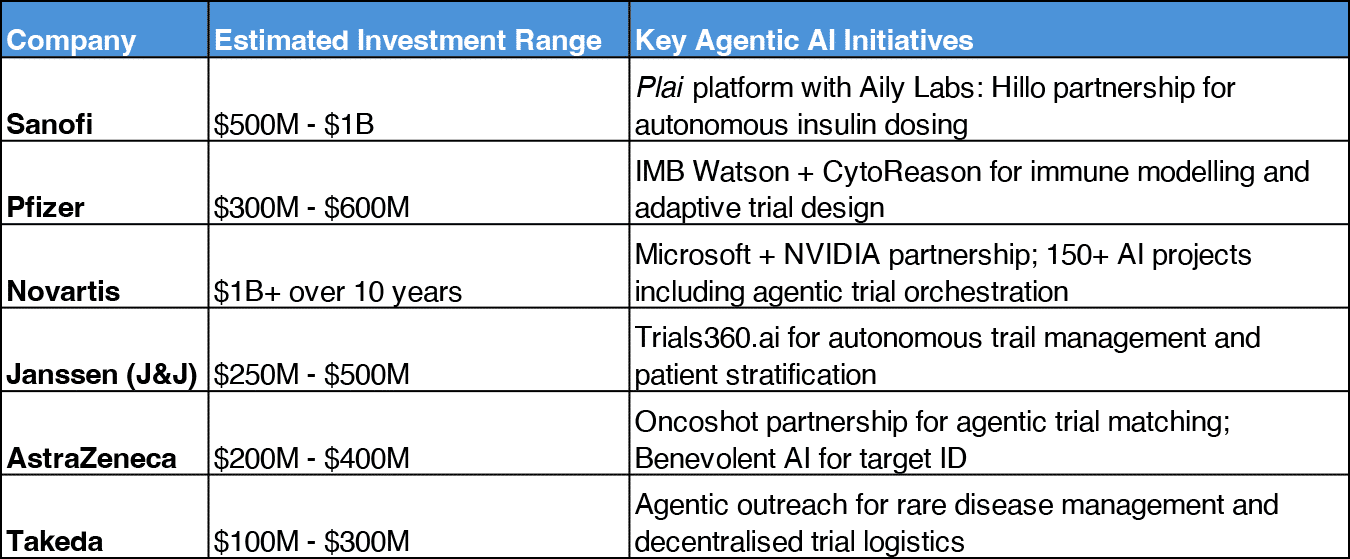
Source: Visiongain Intelligence Centre, 2025
What’s Changed: From Language Models to Molecule Engines
At its core, generative AI uses probabilistic modelling (e.g., transformer architectures) trained on chemical and biological data to invent new compounds.
“This isn’t just automation; this is computational invention.”
Key players making headlines:
- Insilico Medicine – INS018_055 fibrosis drug now in Phase II (designed in under 18 months)
- Recursion Pharmaceuticals – Backed by NVIDIA, integrating high-throughput phenomics
- Exscientia – Partnered with Sanofi and Bayer, using active learning in drug design
These companies are proving that AI-designed assets can not only be discovered rapidly but can meet clinical-grade safety and efficacy thresholds.
What used to take years in silico and in vitro now takes months.
Enter Agentic AI: From Generation to Autonomous R&D
Agentic AI platforms don’t just generate options; they strategically choose them.
Capabilities include:
- Setting complex design goals (e.g., “Design a compound to inhibit KRAS G12D mutation”)
- Running molecular docking simulations
- Adapting based on negative trial data
- Forecasting the market value of candidate drugs
Some experts now refer to this shift as the “AI Operating System” for drug discovery.
In other words, agentic AI is beginning to perform multi-step decision chains that would typically require large, multidisciplinary teams and doing so around the clock, without fatigue or bias.
Market Drivers Fuelling the Acceleration
Several converging forces are accelerating this AI adoption curve:
1. Clinical Validation
The move from computational promise to clinical-stage programs, especially those in Phase I/II, has validated the credibility of generative pipelines.
2. Big Pharma Buy-In
Every top 20 pharmaceutical company is now either investing in, acquiring, or co-developing with AI-native firms. In the past year alone, we’ve seen multi-year licensing deals, multi-billion-dollar M&A conversations, and exclusive R&D partnerships announced almost monthly.
3. Productivity Pressure
With the average cost of bringing a new drug to market exceeding $2.6 billion, and attrition rates still high, AI is seen as a lever to de-risk discovery and compress timelines.
4. Data Maturity
Cloud infrastructure, omics platforms, and the integration of real-world evidence have created the data environment these models need to function effectively. What was once a limiting factor, fragmented, siloed data, is now a differentiator.
Cautionary Signals: Don’t Ignore the Risks
To position as an authority, firms must also address what could go wrong:
- Regulatory Uncertainty: Lack of global standards for AI validation
- Data Bias: Garbage in, garbage out – risk of biased or incomplete training sets
- IP Ambiguity: Who owns an AI-designed molecule?
- Talent Gaps: Most firms are not AI-native and struggle to recruit cross-disciplinary teams
Strategic Priorities for Pharma & Biotech Leadership
This is not an incremental improvement; it’s a fundamental shift in how R&D is conducted. To compete in an AI-powered era, leaders must reframe priorities across the value chain:
- Pipeline Integration: Are you equipped to ingest and prioritise AI-generated candidates within clinical workflows?
- Build vs. Partner: Should you develop proprietary AI infrastructure or align with domain-focused innovators?
- Talent & Culture: Are your teams ready to collaborate with AI systems, or is the capability still siloed across departments?
- Regulatory Preparedness: How will you ensure explainability, auditability, and bias control across submissions?
This is where digital transformation becomes a clinical and commercial imperative, not just a tech upgrade.
Visiongain’s Analyst View
The market is not yet saturated; it’s pre-inflection. The winners won’t be those with the best models, but those who:
- Can scale trust in AI across internal and external stakeholders
- Master the AI + data + regulatory trifecta
- Forge strategic partnerships that transcend mere licensing
We believe the most valuable pharma firms by 2030 will not be those with the largest pipelines but those with the fastest validated pipelines powered by AI.
AI Pharma Landscape: Key Players:
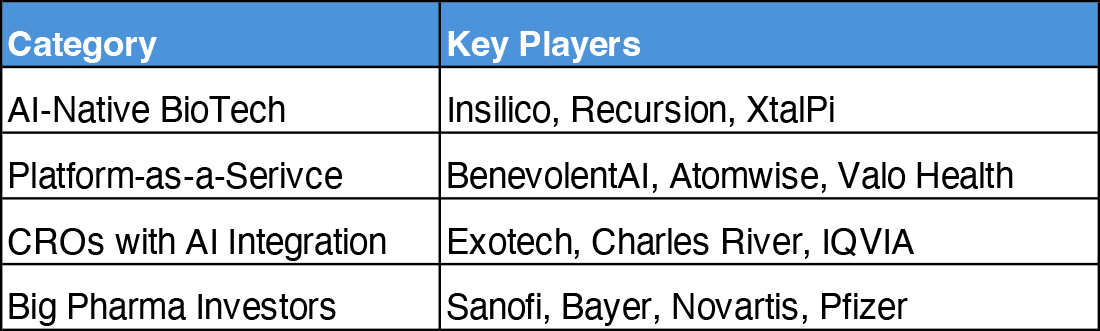
Source: Visiongain Intelligence Centre, 2025
Precision Medicine, Evolved
Generative and agentic AI are now driving the industrialisation of precision, transforming individualised care from an aspiration into an operational reality.
By encoding patient subtypes, molecular profiles, and clinical endpoints into adaptive models, AI enables therapies to be designed, tested, and refined at a commercial scale. Whether aligning targets to tumour biology or dynamically engineering RNA sequences, AI is no longer a supporting tool; it is a strategic engine for competitive differentiation.
Forecast Insight
- AI Drug Discovery Market Forecast (2025–2035)
- Visiongain projects a CAGR of 27.8%, reaching $34.6B by 2030
- Over 40% of early-stage assets could originate from AI by 2035
Stay Ahead with Visiongain
As AI reshapes drug discovery, Visiongain tracks the inflection points that matter, with rigour, clarity, and executive relevance. Our reports are grounded in data, shaped by analyst insight, and aligned with the strategic priorities of decision-makers and leaders across the global health ecosystem.
Explore our latest strategic market reports:


