mRNA Contract Manufacturing: The Emergent White Space for CDMOs

Operational Hurdles in mRNA Manufacturing
mRNA manufacturing presents distinctive challenges, many of which stem from the molecule’s inherent fragility and the complexity of scaling production. CDMOs face significant scientific and logistical constraints, including:
- Molecular Fragility: mRNA is highly prone to degradation during handling, scale-up, or storage, necessitating precise temperature control and careful formulation.
- Precision Formulation: Lipid nanoparticle (LNP) encapsulation must be exact to ensure delivery and protect against enzymatic degradation.
- Purity Standards: Contaminants such as dsRNA, enzymes, or residual DNA must be removed to prevent immune responses, requiring advanced purification systems.
- Supply Chain Constraints: Enzymes, reagents, and nucleotides have limited global suppliers, resulting in sourcing volatility and prolonged timelines.
- Scale-up Variability: Mixing kinetics, shear forces, and LNP batch consistency often break down when transitioning to commercial-scale production.
- Regulatory Ambiguity: As a newer modality, mRNA faces evolving regulatory expectations compared to DNA and viral vectors.
CDMOs: Bridging Innovation and Industrial Scale
To close these gaps, CDMOs are investing in automation, analytics, and cross-platform capabilities. Their technological leadership is essential in translating scientific discovery into scalable, compliant therapies.
- Automated IVT Platforms: Closed-system robotics reduce contamination risk and enable consistent mRNA synthesis through reproducible, automated workflows.
- Real-Time Analytics: Integrated quality controls and analytical tools eliminate dsRNA and other impurities in line, improving product purity.
- DNA Template Production: Some CDMOs are vertically integrating upstream DNA production to streamline timelines and improve quality assurance.
This infrastructure is particularly valuable for small biotech firms that lack in-house capabilities and depend on CDMO expertise for scalability.
Specialised LNP Capabilities: Protecting Payloads, Accelerating Delivery
LNPs are the delivery vehicle of choice for mRNA, protecting the fragile molecule and ensuring precise cellular targeting. Leading CDMOs are building comprehensive platforms that address every stage of LNP formulation.
- Custom Lipid Libraries and Optimisation: CDMOs now offer tailored lipid libraries, including ionisable lipid optimisation to enhance delivery and stability.
- Encapsulation Services at Scale: Reproducibility and consistency are essential for clinical and commercial success. CDMOs are delivering GMP-grade batches to meet these requirements.
- Sterile Fill-Finish Capabilities: From aseptic LNP processing to final dose packaging, CDMOs are accelerating timelines by consolidating services.
Example: BioCina’s end-to-end RNA–LNP platform integrates plasmid preparation, mRNA synthesis, and LNP formulation under one roof, significantly reducing development timelines.
Snapshot: Leading CDMOs with Integrated LNP-mRNA Platforms
A closer look at several CDMOs leading the charge:
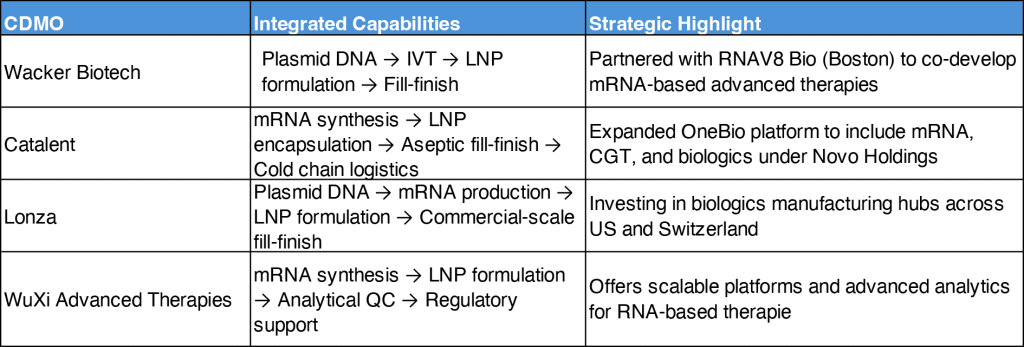
Visiongain Intelligence Centre, 2025
Cold Chain Resilience as Strategic Infrastructure
Cold-chain infrastructure is non-negotiable for mRNA therapeutics. Even minor deviations can compromise drug stability, rendering product batches unusable.
- Ultra-Low Storage: mRNA therapies often require storage temperatures from −20°C to −80°C, with some demanding conditions as cold as −70°C.
- Redundant Infrastructure: CDMOs are investing in backup freezer systems, dual power sources, and validated storage protocols.
- Real-Time Monitoring: IoT-enabled cold-chain tracking offers real-time visibility and deviation mitigation during transport.
These capabilities are essential for CDMOs aiming to serve commercial clients with high-value clinical and therapeutic assets.
Visiongain Analyst Insight: CDMOs without validated −80°C infrastructure and active deviation monitoring risk exclusion from pivotal mRNA contracts. Commercial sponsors are increasingly tying partner selection to proven cold chain maturity, not just theoretical capability.
AI & Robotics: Powering Closed-Loop Manufacturing
AI and robotics are creating a paradigm shift in CDMO operations, improving yield, quality, and compliance.
- Agentic AI: These platforms enable real-time process adaptation, autonomously adjusting manufacturing parameters for optimal performance.
- Automated Workflows: Robotic IVT and LNP systems are reducing human error and increasing batch-to-batch consistency.
- Intelligent CDMO Selection: Sponsors are now using AI tools, including NLP and analytics, to evaluate CDMO performance, sterility history, and audit outcomes.
This intelligent infrastructure will become the standard for future CDMO partnerships.
Visiongain Analyst Insight: As mRNA platforms diversify, LNP formulation expertise is emerging as a critical differentiator among CDMOs. Custom lipid libraries and scalable encapsulation capabilities are now table stakes for sponsors seeking faster time-to-clinic and regulatory readiness.
Key Players and Partnerships Making Headlines
Strategic alliances between biotechs and CDMOs continue to drive momentum in mRNA manufacturing, enabling scale, regulatory readiness, and speed-to-market.
- RNAV8 Bio & Wacker Biotech Announced in April 2025, this partnership focuses on co-developing mRNA-based therapies for oncology and rare diseases. Wacker provides integrated IVT and GMP capabilities to support clinical advancement.
- BioNTech & Rentschler Biopharma: In one of the most visible CDMO partnerships of the past five years, BioNTech and Rentschler formalised their alliance in October 2020 to support downstream processing for the Pfizer/BioNTech COVID-19 vaccine (BNT162b2). Rentschler established a dedicated mRNA suite at its Laupheim site, showcasing agile CDMO response at pandemic scale.
- Moderna & Lonza: This 10-year strategic collaboration began in May 2020 to support the large-scale production of Moderna’s mRNA-1273 and future mRNA-based therapeutics. Technology transfer started in June 2020, and the first batches were manufactured at Lonza’s U.S. facility by July 2020. Lonza’s global biologics infrastructure enabled rapid tech transfer and commercial manufacturing, now considered a blueprint for future mRNA scalability.
These deals illustrate a clear trend:
- End-to-end integration: Sponsors increasingly prefer CDMOs that offer plasmid DNA, IVT, LNP formulation, fill-finish, and logistics under one roof.
- Cold chain readiness: Validated −20°C to −80°C infrastructure is non-negotiable and essential for large-scale commercialisation.
- Digital manufacturing maturity: CDMOs are adopting modular GMP suites, Digital Twins, and predictive analytics to reduce variability, boost compliance, and enable closed-system manufacturing.
Visiongain Analyst Insight: The most successful biopharma CDMO partnerships, such as Moderna–Lonza and BioNTech–Rentschler, are built on end-to-end continuity: plasmid to LNP to fill-finish. This model is rapidly becoming the industry standard for speed, compliance, and investor confidence.
Market Drivers Triggering mRNA Contract Manufacturing
Multiple forces are converging to accelerate mRNA contract manufacturing demand:
- Pipeline Expansion Beyond Vaccines: mRNA is being developed for oncology, cardiovascular, rare diseases and metabolic disorders requiring CDMO expertise and capacity.
- Demand for Next-Gen RNA Modalities: Platforms are evolving beyond standard mRNA into self-amplifying RNA (saRNA) and circular RNA (circRNA), each with unique production needs.
- Personalised Medicine: Neoantigen vaccines and small-batch mRNA therapies demand CDMOs capable of rapid turnaround and batch flexibility.
- Regulatory Complexity: CDMOs are becoming trusted partners in navigating global standards (FDA, EMA, PMDA) and preparing CMC documentation and compliance support.
- Sustainability Pressures: There is a growing demand for greener bioprocessing, efficient energy systems, and sustainable logistics.
- AI & Automation Integration CDMOs are deploying AI for IVT, LNP formulation, and quality control, driving efficiency and consistency at scale.
Strategic Questions for Executives
- Regulatory Complexity: How will you navigate FDA, EMA, and PMDA standards without CDMO support?
- Small Biotech Funding: Can you secure investment without a scalable manufacturing plan? How will you overcome the challenges of a lack of skilled resources?
- Cold Chain Risks: Is your supply chain ready for −80°C cryogenic storage and distribution challenges? How will you mitigate deviation in logistics?
- Digital Infrastructure: Are you investing in AI to reduce variability and improve speed to market?
What’s Next from Visiongain?
At Visiongain, we deliver the intelligence behind the headlines.
Our market reports go beyond surface-level analysis, providing data-driven forecasts, competitive benchmarking, and actionable insights that help pharma and biotech leaders make confident strategic decisions.
Whether you’re navigating platform innovation, assessing CDMO partnerships, or positioning for growth in RNA therapeutics, Visiongain reports give you the clarity and foresight to lead.
Explore our latest strategic market reports:


