Precision Oncology: From Biomarkers to Market Impact

Clinical Trial Surge and FDA Approvals Signal Momentum
Clinical trial momentum in precision oncology continues to accelerate. Between 2019 and 2023, approximately 10,000 oncology trials were initiated globally, with nearly 30% specifically targeting biomarker-defined patient groups. This growth highlights a clear pivot toward personalised cancer therapies.
According to the OncoKB knowledge base, 21 new precision oncology drugs have received FDA approval between 2024 and September 2025, each linked to distinct biomarker-driven indications listed in the National Comprehensive Cancer Network (NCCN) guidelines.
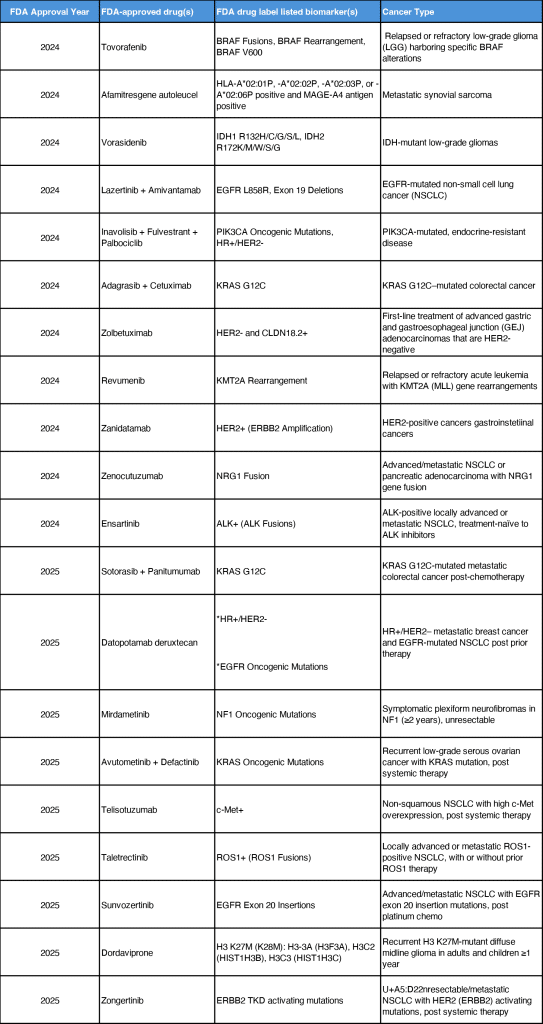
Source: OncoKB and Visiongain, 2025
This shift reflects a profound evolution in drug development, where real-time molecular profiling, biomarker validation, and companion diagnostics are no longer optional; they are central to regulatory approval and clinical adoption.
The rise in biomarker-led trials and approvals signals a strong growth trajectory for precision oncology.
Visiongain Analyst Insight: The pace of biomarker-driven approvals shows that regulatory frameworks are rewarding precision. Companies without companion diagnostic strategies risk falling behind not only in approvals but also in payer adoption.
Precision Oncology as a Technology-Enabled Model
A convergence of technologies is rapidly redefining cancer care, from diagnosis to treatment and monitoring. As these platforms mature, they are enabling more timely, targeted and scalable solutions across oncology.
- Next-Generation Sequencing (NGS): Enables deep genomic profiling to identify actionable mutations faster.
- Liquid Biopsy & ctDNA Monitoring: Non-invasive monitoring for Circulating Tumour DNA (ctDNA) tracks treatment response and early relapse in real time.
- Artificial Intelligence (AI) & Machine Learning: Improve trial design, patient stratification, and interpretation of multi-omic data.
- Single-Cell Omics & Digital Pathology: Reveal detailed views into tumour heterogeneity and immune dynamics, informing resistance and therapeutic response.
- Multi-Cancer Early Detection (MCED) & Theranostics: Emerging platforms such as MCED tests and molecular imaging expand precision medicine beyond traditional care pathways.
Together, these technologies are not only reshaping clinical workflows but also driving the next phase of innovation in precision oncology, fuelled by faster diagnostics, scalable platforms, and improved equity of access.
Visiongain Analyst Insight: Precision oncology is no longer defined by the presence of next-gen tools, but by how fluently they are integrated. The convergence of NGS, AI, and digital pathology is creating steep capability gaps between incumbents and innovators, with CDMOs and biotech start-ups racing to build full-stack solutions.
Multi-Omics and the Systems-Level Evolution of Cancer Care
Precision oncology is evolving beyond mutation-matching towards systems-level models that integrate diverse biological and patient-specific data.
This next phase is being driven by:
- Transcriptomic and proteomic profiling to refine pathway-based interventions.
- Immune signature analysis to optimise immunotherapy decisions.
- Real-world data integration to enhance relevance and treatment adaptability.
- Multi-omics platforms that account for tumour heterogeneity, resistance, and response variability.
- Patient-specific factors such as microbiome, lifestyle, and comorbidities are now considered in treatment planning.
Adaptive trials, liquid biopsy and digital pathology are shifting precision oncology from high-cost personalised care to a more global, scalable model.
Backed by global genomic initiatives and public–private partnerships, precision oncology is positioned to deliver not only predictive and personalised cancer treatment but also participatory care that empowers patients across diverse healthcare systems.
CDMOs: Enabling Scalable Oncology
CDMO partnerships have become a strategic cornerstone in precision oncology, not only accelerating time to clinic but also enabling next-generation treatment modalities.
As demand rises for small-batch, high-potency biologics, Cell and Gene Therapies (CGTs), and Antibody-Drug Conjugates (ADCs), CDMOs are evolving from generalists to specialised collaborators with deep capabilities across critical platforms.
These partnerships deliver:
- Rapid bench-to-clinic translation for biotech start-ups and emerging pipelines.
- Regulatory and compliance expertise in complex biologics, CGT, and ADC manufacturing.
- Modular GMP suites and AI-enabled production lines, boosting scalability and consistency.
- Advanced modality platforms spanning mRNA, radiopharmaceuticals, and personalised dosing infrastructure.
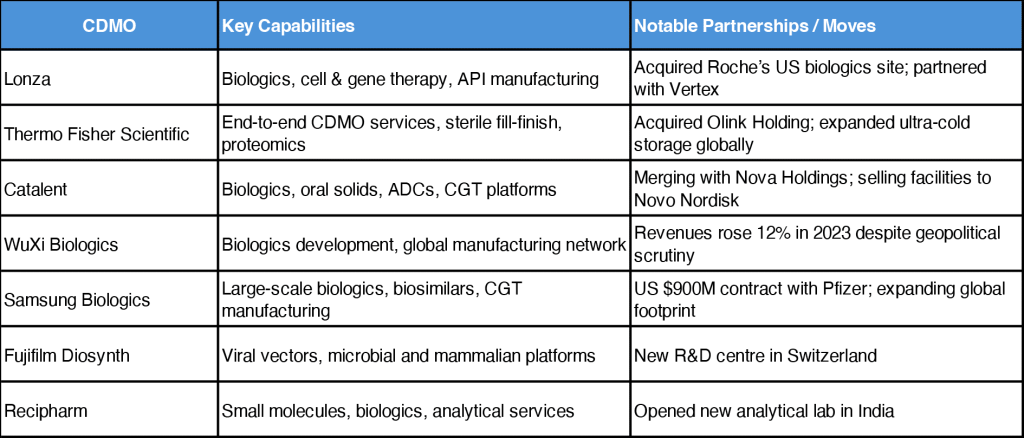
Leading CDMOs in Precision Oncology, Visiongain Intelligence Centre 2025
The most successful CDMOs are no longer service providers; they are core enablers of oncology innovation, market agility, and long-term therapeutic differentiation.

Leading Precision Oncology Companies, Visiongain Intelligence Centre 2025
Visiongain Analyst Insight: Leading CDMOs are evolving beyond capacity providers into full-spectrum innovation partners. Specialisation in ADCs, CGTs, and AI-enabled production is becoming a differentiator in sponsor selection. Those with modular GMP suites and regulatory foresight are best positioned for accelerated pipeline support.
Key CDMO Developments: Precision Oncology at Scale
Samsung Biologics In April 2025, Samsung Biologics announced the opening of its fifth manufacturing plant in South Korea as part of its Second Bio Campus expansion. This facility marks a major shift beyond mRNA and monoclonal antibodies into next-generation oncology treatments, including antibody-drug conjugates (ADCs). The expansion reinforces Samsung’s long-term ambition to become a global leader in multi-modality cancer drug production.
Lonza In October 2024, Lonza finalised its USD 1.2 billion acquisition of the Genentech biologics manufacturing site in Vacaville, California. This strategic investment directly expands Lonza’s precision oncology capabilities, increasing capacity for cell and gene therapies and enabling next-gen biologics manufacturing within the US market.
Visiongain Analyst Insight: As precision oncology pipelines diversify, leading CDMOs are repositioning around modular manufacturing, AI integration, and advanced modality readiness, especially in ADCs, CGT, and personalised biologics. Strategic infrastructure investments are not just about capacity; they are reshaping competitive advantage.
Key Players Making Headlines
Strategic partnerships at the intersection of AI, genomics, and oncology are shaping the next chapter in precision cancer care. Recent moves by major players include:
- Illumina and Tempus AI; In September 2025, Illumina announced a landmark partnership with Tempus AI to advance genomic AI innovation. The collaboration will integrate Illumina’s artificial intelligence technologies with Tempus’s multimodal data platform to train next-generation genomic algorithms. The aim: accelerate clinical adoption of molecular testing across precision oncology pipelines.
- AstraZeneca, Tempus AI, and Pathos AI; In March 2025, AstraZeneca committed USD 200 million to a strategic partnership with Tempus AI and Pathos AI. The initiative focuses on developing a multimodal foundation model for cancer diagnosis and care, integrating genomic, clinical, and imaging data to drive targeted treatment decisions.
- Imagene AI and ARC at Sheba Medical Centre; Also in September 2025, Imagene AI, a leader in real-world multimodal AI for precision medicine, expanded its collaboration with ARC, the innovation arm of Sheba Medical Centre, ranked among the world’s top ten hospitals. This alliance will advance data-driven cancer research and accelerate the translation of real-world evidence into clinical care pathways.
Visiongain Analyst Insight: These partnerships confirm that AI-driven genomics is no longer experimental. It is becoming the operating system of oncology R&D, with early movers gaining a defensible advantage in data and adoption.
Market Drivers Reshaping Precision Oncology
Macro and technological forces are accelerating precision oncology’s commercial and clinical trajectory. These seven stand out:
- Genomic Technology Maturity: NGS platforms from Illumina, Roche, and others are making high-throughput tumour profiling cost-effective, lowering barriers to molecular diagnosis and driving the adoption of targeted therapy.
- AI-Driven Decision Support: AI diagnostics are improving accuracy and workflow efficiency. Tools like Ataraxis Breast have demonstrated up to 30% improvement in detection rates, while machine learning models now integrate multi-omics, imaging, and clinical data to drive personalised treatment decisions.
- Rising Cancer Incidence and Personalisation Demand: With ageing populations, demand is growing for less toxic, stratified therapies. Precision oncology reduces reliance on broad-spectrum treatments through mutation-specific interventions.
- Regulatory Tailwinds: Agencies such as the FDA are fast-tracking biomarker-driven therapies, including KRAS inhibitors and CAR-T treatments, with companion diagnostics now a prerequisite for many approvals.
- Liquid Biopsy Adoption and ctDNA Monitoring: Non-invasive approaches, such as ctDNA analysis, are enabling earlier detection and longitudinal disease monitoring. The NIH is also actively evaluating MCED tools for mainstream adoption.
- Expansion of Precision Therapeutic Classes: Pipelines are increasingly populated by antibody–drug conjugates (ADCs), bispecifics, and RNA-based vaccines. Breast cancer continues to dominate pipeline activity, followed by lung, prostate, and cervical cancers.
- Infrastructure Integration and Access Scaling: Hospitals and diagnostic centres now account for over 45% of end-use market share (2024). Investments in infrastructure and diagnostic capabilities are embedding precision oncology across mainstream care settings, shifting it from niche innovation to clinical standard.
Visiongain Analyst Insight: Precision oncology’s trajectory is now shaped as much by infrastructure and regulatory design as by scientific innovation. Markets able to align diagnostics, trial models, and CDMO scalability will lead the next wave of oncology commercialisation.
Market Outlook: Precision Medicine at an Inflection Point
Precision medicine is shifting from frontier science to an expected standard of care, with commercial success hinging on how effectively sponsors and CDMOs align strategy and scale.
- Scale and Specialise: CDMOs and sponsors that concentrate on ADCs, CGTs, and modular GMP capacity will gain a decisive edge.
- Integrate AI and Multi-Omics: Competitive advantage will be defined not by technology adoption alone, but by how fluently AI, NGS and multi-omic platforms are embedded into trials, diagnostics and treatment pathways.
- Address Access and Equity: The next wave of growth will come not only from advanced markets but also from closing infrastructure and reimbursement gaps in low- and middle-income countries.
The next decade will belong to those who can scale precision medicine globally, marrying science, infrastructure and affordability at speed. For investors, biopharma and CDMOs, it is no longer optional. It is the battleground for growth.
Strategic Questions for Executives
- Are your CDMO partnerships and manufacturing infrastructure aligned with next-generation modalities, including ADCs, CGTs, and mRNA-based therapeutics?
- How are you integrating AI, multi-omic data, and real-world evidence to accelerate trial design, precision diagnostics, and commercial forecasting?
- What is your strategy for improving access, reimbursement, and equity, especially in global markets where infrastructure and regulatory models vary widely?
What’s Next from Visiongain
At Visiongain, we track the strategic shifts redefining oncology from platform innovation and AI-driven trial design to global manufacturing expansion and regulatory evolution.
Our market intelligence is built for decision-makers: data-rich, analyst-led, and commercially focused. Whether you are navigating modality pipelines, evaluating CDMO partnerships, or preparing for the next generation of oncology diagnostics, our reports deliver the clarity and foresight to lead.
Explore Our Latest Strategic Reports:


