Britain Pushes for Faster Counter-Drone Procurement
4 September 2026.

Britain is looking for a more affordable way to defend against large numbers of low-cost drones. Project PANOPTES is offering up to £5 million for technologies that can detect, track and defeat these threats, with laser weapons among the options under consideration.
In this article, we take a look at what the programme says about the MOD’s push to speed up procurement, why directed energy is only part of the answer and what suppliers will need to prove if promising systems are to move beyond trials into service.
Visiongain Top Takeaways
- PANOPTES is aimed at the magazine problem: costly, finite munition stocks are poorly suited to repeated attacks by low-cost UAS.
- Lasers are only part of the requirement: the MOD wants an autonomous, vehicle-mounted system spanning detection, tracking, identification, decision and defeat.
- The £5 million is development funding, not a fielded capability: successful projects could move through later phases towards a future Programme of Record, but further investment is not guaranteed.
- Industrial capacity will matter alongside technical performance: bidders are already being asked how their technologies could be integrated, tested, manufactured at scale and turned into deployable equipment.
Britain Targets the Cost of Drone Defence
PANOPTES is initially focused on representative Class 1 UAS and other small aerial threats, including repeated, sequential and simultaneous attacks. Cheap drones create an unfavourable cost exchange for conventional air defence, but magazine depth is the more immediate military problem. Even an effective system becomes vulnerable if successive engagements run down its available munitions.
The MOD says current approaches are constrained by high engagement costs, limited manoeuvrability, workforce intensity and difficulty adapting as UAS threats evolve. PANOPTES is intended to deal with attacks designed to overwhelm local defences or force the disproportionate use of expensive weapons against relatively inexpensive targets.
The requirement extends beyond deployed land forces to fixed defence infrastructure, where the same pressure on ammunition stocks, personnel and local air defence can apply.
Lasers Are Only Part of the Answer
The MOD is particularly interested in laser directed-energy weapons, but PANOPTES is not tied to a single effector. Lasers could reduce dependence on interceptor missiles and continue engaging targets while sufficient power is available, although they bring practical limits of their own. High-energy lasers normally engage one target at a time and need to hold the beam on it long enough to cause damage, while atmospheric conditions, power generation and cooling can all affect performance. Those constraints become more important when the threat arrives in numbers.
The British Army has already trialled relevant technologies. A high-energy laser mounted on a Wolfhound vehicle destroyed flying drones in 2024, while a Thales UK-led radio-frequency directed-energy demonstrator went on to neutralise multiple targets simultaneously during the Army’s largest counter-drone swarm exercise in 2025. More than 100 drones were engaged across the RFDEW trials, including two swarms in a single engagement.
Those approaches do different jobs. A laser provides a precise hard kill against an individual target, while radio-frequency weapons can affect several susceptible electronic systems at once. Neither removes the need for other layers of defence, particularly as drones become harder to disrupt electronically.
The threat is already changing in that direction. In March, UK Defence Innovation separately sought technologies to counter fibre-optic-controlled UAS, drawing directly on developments seen in Ukraine. These aircraft use a physical cable for control and are immune to conventional radio-frequency countermeasures, increasing the need for systems that can switch between different sensors and ways of defeating the target.
PANOPTES reflects that broader requirement. The MOD wants a vehicle-mounted system able to detect, track, identify, decide and defeat threats, with autonomous operation, platform-generated power and an open, modular architecture. Integration with a future uncrewed ground vehicle is also planned, while the system should provide a route towards wider Army and Joint Ground-Based Air Defence capabilities.
The MOD Is Testing a Faster Procurement Route
PANOPTES is being run through the Commercial X Dynamic Market as a regulated procurement under the Procurement Act 2023. Suppliers have until 23 September to submit a short, high-level programme outline, with successful applicants moving to detailed Stage 2 bids due on 29 October. The MOD aims to begin Phase 1 contracts in November or December.
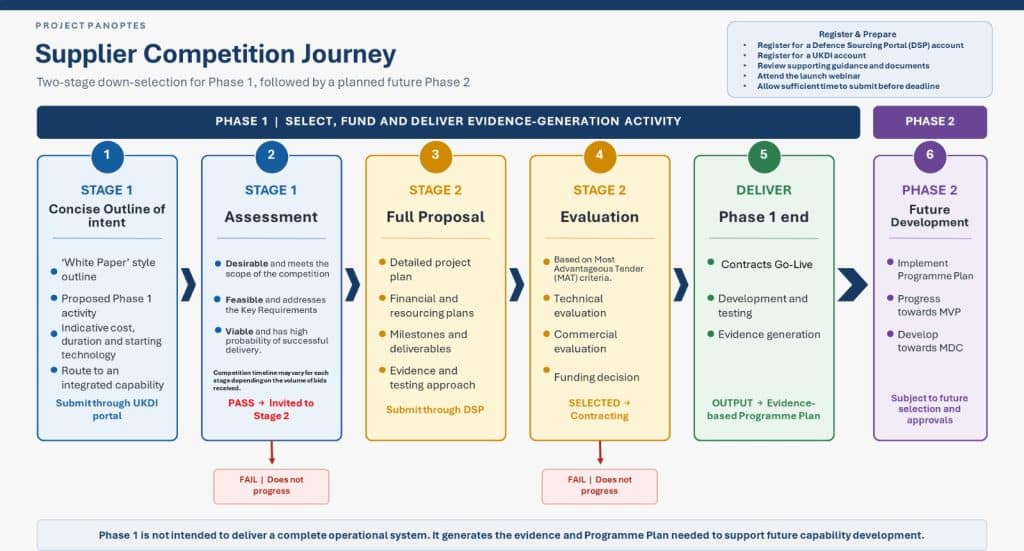
Up to £5 million is available across multiple Phase 1 projects lasting no more than six months. The focus is on maturing existing technologies rather than starting long-term research, while the MOD is encouraging companies to combine public funding with their own investment. Its stated aim is to move suitable capabilities towards operations in under two years.
Later phases could take selected technologies through Minimum Viable Product and Minimum Deployable Capability stages before any wider adoption through a future Programme of Record. Progression is discretionary and remains subject to further approvals, contracts and funding.
There is potentially more money behind the requirement than the initial competition suggests. The associated CUAS Exploration tender notice gives an estimated value of £125 million excluding VAT, or £150 million including VAT. The notice also makes clear that this is an indicative figure aligned with current planning rather than approved programme funding, so it should not be treated as a £125 million contract award.
The Delivery Test Comes After Phase 1
Phase 1 will not deliver an operational C-UAS system. Its main output is an evidence-based programme plan supported by development work, demonstrations, modelling, analysis and testing, giving the MOD a basis for deciding what should progress.
The competition is notable for asking suppliers to address industrialisation early. Stage 1 submissions must explain how an integrated system could be scaled and put into production, while bidders are also expected to consider cyber security, representative environmental testing, integration with existing technologies and the collaborations needed to reach an operational product.
This is a demanding step for smaller defence technology companies. A system that works in a demonstration still needs manufacturing capacity, qualified components, military testing, software and systems integration, support arrangements and enough capital to move into production. The pace of UAS development adds further pressure because equipment that takes several years to reach service may face a different threat from the one that shaped the original requirement.
PANOPTES is therefore testing more than the speed of the application process. The MOD can shorten the route into funded development, but the value of that approach will depend on whether the same urgency survives industrialisation and fielding.
Market Outlook
PANOPTES gives both domestic and international suppliers a route into the programme, provided they have a UK presence. Applicants must be based in the UK and carry out the work there, but they do not have to be UK-owned. Suppliers also retain ownership of their intellectual property, which is relevant to technology companies deciding how much proprietary capability to commit during early development.
The MOD has asked bidders to consider wider applications and possible export opportunities, while the integrated nature of the requirement leaves potential roles across sensing, command systems, directed energy and other effectors, vehicle integration and manufacturing. Specialist suppliers may be able to enter individually at the development stage, but partnerships are likely to become more important as systems move closer to military production.
The £5 million competition is best viewed as an entry point rather than the size of the eventual opportunity. The more important commercial question is how many technologies survive subsequent selection and whether the MOD commits the funding needed to buy an operational system in useful numbers.
PANOPTES has a deliberately short route into development. Whether it becomes a useful model for wider defence procurement will depend on what happens afterwards, when testing, production and military acceptance replace application deadlines as the main determinants of speed.
Visiongain Insight: PANOPTES should favour suppliers that can place specialist counter-UAS technology within a wider architecture and show a credible route to manufacture. Retained IP, potential export applications and the indicative scale of the wider requirement add to the commercial interest, but the larger opportunity still depends on follow-on procurement being funded.
From Visiongain
Visiongain’s market reports provide detailed forecasting and analysis to assess how these structural shifts will translate into long-term demand, investment priorities and competitive positioning.
Explore the Visiongain Drones & UAV Intelligence Hub for the latest analysis, market intelligence and research across drones and counter-UAS.
- Counter-UAV (C-UAV) Market Report
- Directed Energy Weapons (DEW) Market Report
- Anti-Drone Market Report
- Military Radar System Market Report
- Military Identification Friend or Foe Market Report
Press & Media Enquiries
For commentary, data requests or interview enquiries, please contact: press@visiongain.com