EV Battery Systems Market to reach US$459.75bn
9 October 2026.
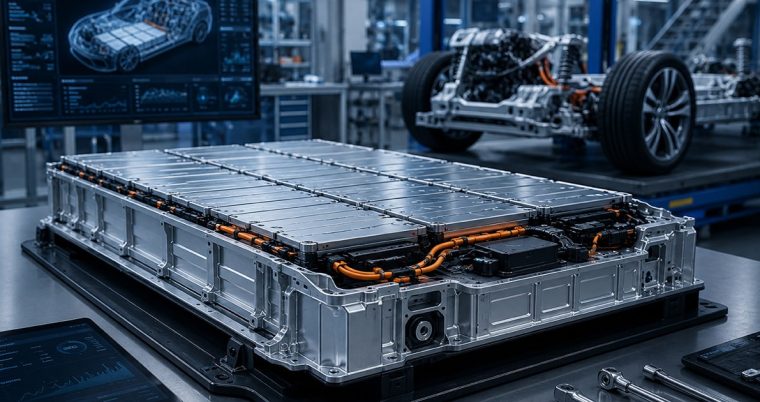
Visiongain has released its new EV Battery Systems Market Report 2026-2036, forecasting that the global market will grow from US$142.55 billion in 2026 to US$459.75 billion by 2036.
The market is forecast to expand at a compound annual growth rate (CAGR) of 12.4% between 2026 and 2036, building from a 12.1% CAGR between 2026 and 2031 to a 12.8% CAGR between 2031 and 2036, as LFP chemistry adoption widens and battery thermal management content per vehicle rises.
Key Market Growth Drivers & Industry Transformations
The EV battery systems market is undergoing a structural transition in which pack design, chemistry selection, thermal safety, and structural integration are becoming just as critical as cell-level performance. Visiongain’s research identifies four key catalysts driving market expansion:
- LFP Chemistry Extends Beyond Entry-Level Platforms: Lithium Iron Phosphate (LFP) is both the largest and among the fastest-growing chemistries, expanding at a 12.8% CAGR to US$268.96 billion by 2036, as its cost and safety advantages extend into premium and commercial vehicle segments. In April 2026, CATL introduced the third-generation Shenxing LFP battery, explicitly positioning the chemistry around extreme fast charging rather than competing on energy density alone.
- Cylindrical Cell Formats Gain Share: Cylindrical Batteries are the fastest-growing battery form at a 13.4% CAGR, reaching US$114.97 billion by 2036, on manufacturing scalability and thermal performance advantages.
- Thermal Management Content Rises: Battery Thermal Management Systems (BTMS) are the fastest-growing system component at a 14.1% CAGR, reaching US$33.11 billion by 2036, as higher charging rates and pack capacities demand more sophisticated cooling architectures.
- OEM Vertical Integration Accelerates: Automakers are increasingly building in-house cell manufacturing capacity in response to recent supply-chain disruption, led by Volkswagen Group’s PowerCo SE, which commissioned its first European gigafactory at Salzgitter, Germany in December 2025, producing standardised Unified Cells intended to cover approximately half of the VW Group’s long-term cell demand.
Major Competitive Disruption Reshapes the Cell Manufacturing Landscape
The battery cell supply chain has experienced substantial competitive turbulence over the past two years. Northvolt AB, once Europe’s most prominent independent battery cell developer, filed for Chapter 11 protection in the United States in November 2024 and subsequently for bankruptcy in Sweden in March 2025, the largest industrial insolvency in modern Swedish history. US-based Lyten agreed in August 2025 to acquire the bulk of Northvolt’s remaining assets, including its Skellefteå manufacturing site, but the deal did not close until 27 February 2026; Lyten is targeting commercial cell shipments from the site during the second half of 2026.
Not every OEM-backed venture has scaled as smoothly, however: Automotive Cells Company (ACC), the joint venture of Stellantis, Mercedes-Benz and TotalEnergies, has definitively shelved its planned Kaiserslautern, Germany and Termoli, Italy gigafactories as of early 2026, leaving its Billy-Berclau/Douvrin facility in France as its only operating plant. The divergence between PowerCo’s successful Salzgitter ramp-up and ACC’s scaled-back ambitions illustrates that OEM backing alone does not guarantee successful gigafactory execution.
Executive Quote
“The battery systems industry is undergoing a structural shift toward OEM-affiliated cell manufacturing, but the divergent fortunes of ventures like PowerCo and ACC show that automaker backing alone does not guarantee successful gigafactory execution,” stated a Senior Automotive Analyst at Visiongain.
“Capital discipline, chemistry flexibility and realistic demand planning remain the decisive factors separating successful battery ventures from the growing list of stalled or failed projects,” the analyst added.
Scope of the Visiongain Report
The 480+ page report provides robust quantitative and qualitative analysis across all key facets of the global market:
- By Battery Chemistry: Lithium Iron Phosphate (LFP); Nickel-Based Batteries.
- By Battery Form: Prismatic; Pouch; Cylindrical.
- By Battery Capacity: Below 30 kWh; 30 to 60 kWh; 60 to 100 kWh; Above 100 kWh.
- By Vehicle Type: Passenger Cars; Light Commercial Vehicles (LCVs); Medium & Heavy Commercial Vehicles (M&HCVs); Buses; Other Vehicle Types.
- By Battery System Component: Battery Cells; Modules & Enclosures/Pack Structure; BMS; BTMS; Wiring Harnesses & Connectors (BDU/HV); Other Components.
- By Regional & Country Markets: North America, Europe, Asia Pacific, Latin America, and Middle East & Africa.
Competitive Landscape
The competitive environment is characterised by intense competition, strategic long-term battery-material and cell supply agreements, and aggressive capital investment in gigafactory capacity. Major market participants evaluated in the report include:
- CATL
- BYD
- LG Energy Solution
- Panasonic Energy
- Samsung SDI
- SK On
- CALB
- Gotion High-Tech
- EVE Energy
- Sunwoda Electronic
- SVOLT Energy Technology
- AESC Group
- PowerCo SE (Volkswagen Group)
- Automotive Cells Company (ACC)
- Robert Bosch GmbH
Recent Developments
- 17 Dec 2025 – PowerCo SE (Volkswagen Group) commissions its first European gigafactory at Salzgitter, Germany, producing standardised Unified Cells intended to cover approximately half of the VW Group’s long-term battery cell demand.
- 27 Feb 2026 – Lyten completes its acquisition of Northvolt’s Skellefteå assets, including the manufacturing site in Sweden, more than six months after the August 2025 agreement was announced; Lyten is targeting commercial cell shipments during the second half of 2026.
- Feb 2026 – Automotive Cells Company (ACC) confirms its Kaiserslautern and Termoli gigafactories are definitively shelved, leaving its Billy-Berclau/Douvrin facility in France as its only operating plant amid slower European EV demand and cost pressure.
Related Reports
Automotive Cybersecurity Market Report 2026-2036
In-Vehicle Digital Experience Market Report 2026-2036
Solid-State Car Battery Market Report 2025-2035
EV Battery Recycling & Second-Life Market Report 2026-2036
Mobility-as-a-Service (MaaS) Market Report 2025-2035
Electric Vehicles (EV) Market Report 2025-2035
About Visiongain
Established in 1998, Visiongain is an independent publisher of analyst-led market intelligence, delivering data-driven research, forecasts, and strategic insight across global industries and emerging markets. Visiongain supports evidence-based decision-making for investment, procurement, and long-term strategic planning.
Media Contact
press@visiongain.com
+44 (0)20 7336 6100
www.visiongain.com