Why Batteries, Bauxite and Magnets Are Becoming Defence Priorities
14 August 2026.
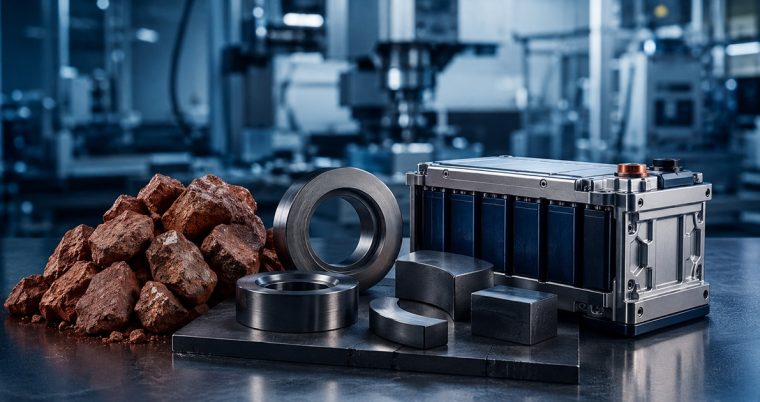
The next constraint on US weapons production may not be a missile factory or drone assembly line. It may be access to the batteries, minerals and magnets that feed them.
Washington is putting government capital behind that concern. New financing for advanced battery materials, refractory-grade bauxite and rare earth-free magnets is aimed at reducing vulnerabilities in supply chains exposed to foreign production and processing, with China the central concern. Beijing’s controls on critical-mineral exports have reinforced the risks created by concentrated supply.
The US cannot bring every strategic supply chain home. It must decide which dependencies are too risky to tolerate, which can be diversified through regional or allied supply, and which can be designed out altogether.
In this edition, we examine how Washington is trying to answer that question, and what it could mean for the defence industrial base.
Visiongain Top Takeaways
- Washington is intervening further upstream: Recent financing targets advanced battery materials, refractory-grade bauxite and permanent magnets, reflecting growing concern over the inputs that underpin military production.
- There is no single model for securing supply: The US is combining domestic manufacturing, regional sourcing and alternative technologies rather than trying to bring every critical-material chain onshore.
- China remains the strategic pressure point: Beijing’s critical-mineral export controls have highlighted the risks of concentrated supply, while US-backed alternatives still need to prove they can compete at scale.
Batteries Become a Defence Issue
The largest of the latest measures is a US$1.4 billion conditional loan commitment from the Office of Strategic Capital (OSC) to Sila Nanotechnologies.
The proposed financing, in line with the Department’s Advanced Battery Strategy and alongside external equity, would support expanded production of silicon-carbon battery anodes and lithium-ion cell manufacturing capacity.
Sila had already raised US$300 million in private funding in July to support further expansion at its Moses Lake, Washington plant. The round was led by Atreides Management and Sutter Hill Ventures, adding substantial private capital to the proposed government backing.
The Department identifies unmanned aerial systems, satellites and munitions among the potential defence applications, alongside commercial markets including energy storage and data centres. OSC Director David A. Lorch described advanced batteries as “important enabling components” for the defence industrial base and wider US economy.
Defence demand sits within a broader battery market largely shaped by commercial applications. Securing military supply therefore depends partly on investment and manufacturing decisions made outside the traditional defence sector.
Peter B. Zuckerman, OSC Senior Managing Director, said Sila could eventually meet a “material portion of U.S. core anode demand”. If achieved, that would make the project more than another domestic manufacturing facility: it could materially reduce US exposure to imported anode supply.
The commitment still has to meet financial, legal and technical requirements before financial close. Its strategic value will depend on whether Sila can turn government-backed expansion into competitive production at scale.
Bauxite Shows the Limits of Onshoring
The Department’s Economic Defense Unit and Industrial Base Analysis and Sustainment programme have agreed a US$85.5 million equity investment in Strategic Bauxite USA, alongside US$64.5 million of private-sector capital.
The agreement supports Strategic Bauxite’s acquisition and expansion of First Bauxite in Guyana, additional calcination capacity and a follow-on brown-fused alumina facility in the United States. First Bauxite announced in July that Strategic Bauxite had acquired the company.
The Department says the completed project could meet all US military demand for brown-fused alumina and all US demand for refractory-grade bauxite. Refractory-grade bauxite is used in high-temperature materials for heat shields, thermal barriers and turbine engines across missiles, rockets, aircraft and space systems. It also serves wider industrial markets, including steel, aluminium and energy infrastructure.
Michael Cadenazzi, Assistant Secretary of War for Industrial Base Policy, said defence readiness depends on “secure, regional access to critical minerals”. The wording is significant: extraction is centred in Guyana, while more of the downstream processing would sit in the United States.
This is not straightforward reshoring. Washington is trying to build a more secure Western Hemisphere supply chain while reducing reliance on refractory-grade bauxite sourced from China or Chinese-owned entities.
IBAS says its equity and direct investments target bottlenecks where long development timelines have historically discouraged private capital. Government funding is therefore being used to support a supply chain whose strategic importance extends beyond its immediate defence market.
The project also demonstrates the limits of domestic extraction as a security strategy. Greater resilience will depend on regional supply as well as control over strategically important processing stages.
Magnets Offer a Way Around Rare-Earth Dependence
OSC has made a separate US$150 million conditional loan commitment to Niron Magnetics to expand production of rare earth-free permanent magnets.
Rather than trying to reproduce the conventional rare-earth supply chain in the United States, Niron makes magnets from iron and nitrogen. The technology follows more than a decade of research and development and is intended to reduce dependence on foreign-produced rare-earth magnets.
A two-year pilot project supported by the Department of Energy’s Advanced Research Projects Agency-Energy produced around one to two tons of magnets a year. OSC financing, alongside private capital, would support a US$605 million plant in Sartell, Minnesota, designed to produce up to 1,500 tons annually.
That is a substantial jump from pilot output to industrial production. Manufacturing consistency, cost and customer qualification will determine whether Niron can turn an alternative material into a viable source of high-performance magnets.
Zuckerman said “high-performance magnets are integral to the U.S. economy and defense industrial base”, with their importance expected to grow across electrification, robotics and defence modernisation. Lorch presented the investment as a way to reduce a supply-chain vulnerability and exposure to geopolitical disruption.
Niron is also only one part of the US response. MP Materials, already backed through a major public-private partnership with the Department, is expanding a conventional US rare-earth mine-to-magnet supply chain. Washington is therefore pursuing both routes: building domestic rare-earth capacity while supporting technologies that could reduce the need for rare earths altogether.
Niron still faces a major transition from pilot output to commercial production. Its strategic value will depend on whether rare earth-free technology can meet performance and cost requirements at scale.
Three Different Routes to Resilience
The projects show that Washington is not relying on a single model of reshoring. Sila expands domestic manufacturing, Strategic Bauxite combines regional extraction with greater control over processing, while Niron attempts to remove a vulnerable raw-material requirement altogether.
The financing differs too, ranging from OSC conditional loans to direct government equity alongside private capital. The common objective is not complete self-sufficiency, but reducing the risk that the loss of one supplier, country or processing route can disrupt military production.
Market Outlook
Government capital is reaching further into industries that sit upstream of weapons production. Mining groups, advanced materials and processing companies, battery manufacturers and specialist technology companies increasingly matter because weaknesses at their level can ultimately constrain military output.
The three projects form part of roughly US$3 billion in critical-minerals and battery initiatives announced on 7 August. The wider package also included a US$400 million conditional OSC loan to Sunrise Energy Metals for its scandium project in Australia, another indication that allied supply is part of the strategy alongside domestic production.
OSC separately says it has committed more than US$8.4 billion in debt financing during FY26 and mobilised more than US$17.8 billion in public and private capital for the US industrial base.
Financing commitments are not the same as new industrial capacity. New facilities need sustained demand, while alternative technologies must prove competitive on cost, performance and scale. Domestic or regional production may also remain more expensive than established imports.
The results will be visible in output: how much new capacity reaches production, whether alternative materials can be qualified and manufactured at scale, and whether exposure to concentrated foreign supply actually falls.
Visiongain Insight
Strategic value is moving further upstream in the defence economy. A company does not need to manufacture missiles, aircraft or drones to become important to military readiness; control of a difficult-to-replace material, process or technology can be enough.
That shift could change where defence-sector opportunities emerge. Materials producers, processors and technology companies that have traditionally sat outside prime-contractor supply chains may attract greater government funding, strategic partnerships and investment where they can remove a critical dependency.
Government capital can accelerate that shift, but strategic importance alone will not guarantee a viable supplier. Cost, qualification, production scale and sustained demand will determine which projects become durable parts of the defence industrial base.
From Visiongain
Visiongain’s market reports provide detailed forecasting and analysis to assess how these structural shifts will translate into long-term demand, investment priorities and competitive positioning.
- Advanced Materials in Aerospace and Defence Market Report 2026-2036
- Directed Energy Weapons (DEW) Market Report
- U.S. DoD & Space Force Budget Market Report
- Anti-Drone Market Report
- Military Radar System Market Report
- Military Identification Friend or Foe Market Report
Press & Media Enquiries
For commentary, data requests or interview enquiries, please contact: press@visiongain.com