DroneX 2026: Scaling Drone Manufacturing Beyond the Battlefield
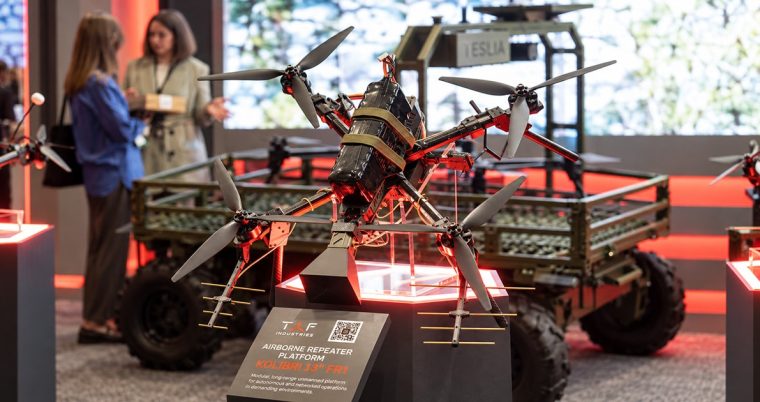
DroneX 2026, held at ExCeL London on 29–30 September, highlighted the pressure on manufacturers to turn rapid advances in drone technology into affordable, reliable military capability.
High-speed interceptors, fibre-optic FPV drones and new power-management systems reflected lessons from Ukraine, where electronic warfare and changing threats demand constant adaptation.
Manufacturers must match that pace of development with sufficient production capacity, affordable components and dependable supply chains.
Visiongain Top Takeaways
- Battlefield experience is accelerating development: Ukrainian manufacturers are adapting systems rapidly to counter new threats.
- Power remains a critical constraint: New approaches to battery management and charging could improve endurance and operational flexibility.
- Production needs to accommodate rapid change: Modular designs and flexible manufacturing can help suppliers maintain output as systems evolve.
- Component sourcing carries growing risks: Dependence on Chinese-origin components and US procurement restrictions are complicating supply decisions.
Battlefield Adaptation Tests Defence Production
Drone manufacturers and service providers face pressure to turn battlefield feedback into production changes faster than many conventional defence procurement cycles can accommodate.
The scale of Ukraine’s drone industry illustrates the challenge. In July, Reuters reported a Pentagon estimate that Ukraine would produce six to seven million small FPV attack drones in 2026, roughly 500,000 a month. By comparison, the Pentagon’s $1.1 billion Drone Dominance programme expected to order fewer than 200,000 drones in total by February 2027.
Ukraine has shown how quickly operational requirements can change. Electronic warfare can disrupt drone communications and navigation, while advances in counter-drone technology can force changes to payloads and platform design.
Russia’s Geran programme provides another example. A September 2026 analysis by the Center for Strategic and International Studies (CSIS) documents repeated changes to navigation, communications and payload systems in response to Ukrainian countermeasures, with battlefield feedback shaping production decisions within weeks.
Manufacturers that can test and introduce modifications quickly, without disrupting output or driving up costs, will have an advantage.
Power Remains a Technical Constraint
Battery performance continues to limit drone range, payload and time in the air.
At DroneX, exhibitors presented different approaches to the problem. Stellarion’s battery-dropping system is designed to reduce weight during flight, TAF Industries’ PowerKey conserves energy before launch, and Inductive Power Projection demonstrated wireless charging technology intended to reduce manual intervention between missions.
The potential benefits range from greater endurance to faster turnaround and reduced support requirements.
Defence customers will need to assess whether these gains justify the additional cost, weight and complexity, and whether the technologies perform reliably under operational conditions.
Drone Production Demands Greater Flexibility
Increasing production without losing the ability to modify designs is a growing challenge for drone manufacturers.
Standardised components can simplify procurement and assembly, while modular designs allow manufacturers to introduce upgrades without redesigning entire platforms.
At DroneX, Ukraine’s Skyfall displayed its P1-SUN interceptor, which incorporates a modular airframe with partially 3D-printed components intended to simplify production and repair. It illustrates how additive manufacturing could reduce dependence on conventional tooling for selected parts.
The challenge is maintaining consistent quality and competitive unit costs as production increases and designs change.
Component Sourcing Becomes a Defence Procurement Risk
Western small-drone production remains exposed to Chinese-origin components and materials. RUSI’s November 2025 report, Drones: Decoupling Supply Chains from China, identifies this dependence as a significant vulnerability for NATO and allied manufacturers.
US procurement rules add to the pressure. Section 848 of the National Defense Authorization Act for Fiscal Year 2020, as amended, restricts the Pentagon’s procurement and operation of certain foreign-produced drones and systems containing specified components from China and other covered countries.
Manufacturers seeking compliant alternatives may face higher costs, limited availability and additional qualification requirements.
A technically capable drone may still be ineligible for a defence contract if it fails to meet the applicable procurement rules. Suppliers must therefore balance affordable production and reliable delivery against the need for secure, compliant components.
Visiongain Insight
Ukraine’s move towards drone procurement informed by frontline performance could have important consequences for suppliers. A system’s effectiveness in combat, and its ability to improve as threats change, may increasingly influence purchasing decisions.
This could favour manufacturers with established military customers, proven delivery records and the ability to support upgrades after deployment.
Investors should distinguish between companies attracting attention with new technology and those securing repeat orders at sustainable margins. Battlefield success can generate demand, but it does not guarantee lasting revenue.
From Visiongain
Primary Research: US Drone Manufacturing
Visiongain is conducting an independent study, commissioned by the Manufacturing Technology Deployment Group (MTDG), examining US drone manufacturing capability, supply-chain constraints and procurement requirements.
Through confidential interviews with manufacturers and drone service providers, the research will identify practical challenges in building and sustaining trusted domestic production.
US drone industry participants are invited to contribute to the study.
Market Intelligence
Visiongain’s market reports examine how changing military requirements, procurement priorities and technology developments are shaping market demand, investment opportunities and competitive positions.
Explore the Visiongain Drones & UAV Intelligence Hub for the latest analysis and market intelligence across unmanned systems.
Press & Media Enquiries
For commentary, data requests or interview enquiries, please contact: press@visiongain.com


