DroneX 2026: An Ecosystem Evolving at Speed
1 October 2026.
Visiongain Market Watch | Final Dispatch
Ukraine war innovations, maturing power solutions and regulatory changes shape DroneX 2026.
One of the most striking features of DroneX 2026 was the prominence and number of Ukrainian companies at the exhibition.
The reasons are clear. Ukraine is manufacturing 500,000 to 800,000 drones every month. It is also the only country aligned with the West with significant and prolonged experience of using drones in actual combat against a major military power. In the first three quarters of 2026, the military secured over 590,000 UAVs through the official Brave1 Market platform, with interceptors leading demand.
Ukrainian exhibitors including Stellarion, TAF Industries, General Cherry and Skyfall demonstrated both the diversity and increasing specialisation of unmanned systems, as well as the speed at which they are evolving.
But the significance of what was on display extended beyond individual platforms. DroneX provided a view of a rapidly developing ecosystem, and the corresponding demands this is placing on component development, supply chains, power technologies and regulation.
Follow the technologies, markets and industrial challenges shaping the drone sector.
Ukraine’s Battlefield Experience Drives Rapid Development
The range of Ukrainian systems on display illustrated the speed and diversity of current drone development.
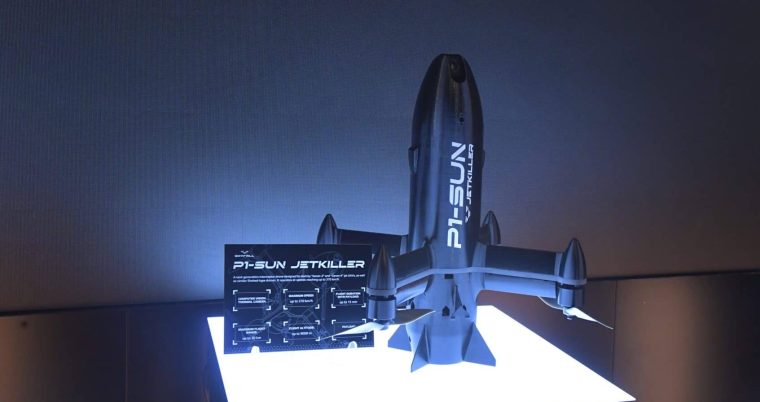
Skyfall displayed its Vampire heavy bomber drone, Shrike FPV strike drones, tactical reconnaissance platforms and P1-SUN interceptor, also known as JetKiller.
The P1-SUN is a high-speed FPV interceptor designed to detect, pursue and destroy aerial targets such as loitering munitions and attack drones. Its modular airframe includes partially 3D-printed components intended to support rapid production and repair, reflecting the emphasis on relatively low-cost responses to mass drone attacks.
General Cherry presented a similarly broad range of interceptor and strike systems.
Its Bullet counter-Shahed platform is designed to neutralise loitering munitions and other aerial threats, reaching speeds of 185–310 km/h with an 800g payload and 20 km range. The system integrates Alta Ares AI-powered terminal guidance.
General Cherry AIR, meanwhile, is a frontline interceptor cruising at 170 km/h, with a 35-minute flight time and maximum altitude of 6,800 metres. General Cherry AIR Pro is capable of speeds over 200 km/h, while AIR Speed, built on an 8-inch frame, can reach speeds of up to 240 km/h.
The company also displayed FPV kamikaze models ranging from 7-inch to 10-inch frames and the 15 OPTIX long-range optical platform, equipped with a 640-resolution night camera and an operational range of up to 35 km.
The breadth of these configurations demonstrates the increasing specialisation occurring within counter-UAS and strike-drone development.
TAF Industries provided another illustration of how extensive this ecosystem is becoming.
Its Kolibri family encompasses multiple configurations, including 7-, 8-, 10-, 13- and 15-inch tactical strike drones. The Kolibri Optic Fiber series uses integrated optical-fibre coils to provide immunity from electronic warfare, while the Kolibri 10 Advance has an operational range exceeding 40 km.
The Kolibri 13 FR1 is a modular long-range FPV relay carrier designed to extend command-and-control connections in difficult terrain and heavy electronic-warfare environments.
TAF also displayed the Kolibri-i10 and Octopus-100 reconnaissance and combat platforms; the TAF-U1 Babka reconnaissance UAV; LEGIT L1 and S1 unmanned ground vehicles; and Teslia, a UGV capable of carrying up to 180 kg.
Alongside the platforms were configurable electronic-warfare systems and specialist components including TAF-P2U and TAF-P2 initiation and detonation safety boards.
The significance is not simply that more drone types are appearing. Rapid operational change is creating increasingly specialised systems and requiring platforms, communications, electronic warfare, payloads and components to develop alongside one another.
Beyond the Drone: A Wider Technology Ecosystem
Stellarion provided another example of how quickly individual platforms are developing into broader families of systems.
The company stated at DroneX that its portfolio includes more than 30 modifications of combat UAVs, with production capacity of up to 30,000 drones per month.
Its flagship Deadliner Q1 is a 10-inch fibre-optic FPV drone built for strike missions in heavily contested environments. Stellarion stated at the exhibition that the Q1 ranked first by number of sorties conducted by Unmanned Systems Forces units and second in the overall ranking of Armed Forces of Ukraine strike systems in July 2026.
The Deadliner line is also qualified in the Drone Dominance programme of the U.S. Department of War.
Stellarion’s Deadliner EFIR carries a repeater module and flies alongside radio-controlled Deadliner drones. The repeater modules are interchangeable and the video link is encrypted.
These systems illustrate a wider point emerging from DroneX: the development of the drone itself cannot be separated from the technologies around it. Communications, electronic warfare, sensors, power, payloads and supporting infrastructure are increasingly integral to the effectiveness of the overall system.
New Approaches to the Power Challenge
Power was another important area of development at DroneX and has been identified as a bottleneck in the Drone Dominance initiative.
Several technologies at the exhibition demonstrated different approaches to addressing the problem.
TAF Industries’ PowerKey delayed-start system addresses battery consumption while an FPV or reconnaissance drone is positioned forward waiting for a target.
In this situation, internal components continuously draw power. TAF Industries explained that competitor solutions can leave the flight controller running, draining 30% to 40% of the battery before the drone even takes off.
PowerKey completely shuts down the flight controller and electronic components while the drone waits, rebooting and initialising the systems only when triggered. The system supports up to six drones with a 36-hour standby capability.
Stellarion is approaching the power problem differently.
Its proprietary battery-dropping module allows a drone to drop spent battery cells during flight, reducing its weight and extending total range, hover time and payload capacity.
The Deadliner R15, for example, has a 2.5 kg payload capacity and a 65 km operational range made possible by the battery-dropping module.
The Deadliner R10/W10 has a 1.4 kg payload capacity, a 30,000 mAh battery system and an operational range of up to 50–60 km using the battery-dropping layout.
A third approach came from Inductive Power Projection (IPP), which presented its MHz wireless-charging technology at DroneX.
IPP demonstrated inductive charging for a UAV at the exhibition. Its technology removes the need for human or mechanical intervention, enabling autonomous power delivery for civilian and defence applications.
The company states that its technology offers high-power transfer of up to 10KW+, bi-directional charging and the capability to transfer data, alongside 98% efficiency between ring to ring.
Another potentially important feature is its tolerance of poor alignment, allowing charging to continue in less controlled operating environments.
IPP explained that its technology has applications across subsea, land, air and space, with rugged power units also being developed for UUVs and other undersea assets.
The approaches are very different, but each demonstrates how the power challenge is expanding beyond simply increasing battery capacity. Energy conservation, changing aircraft weight during flight and autonomous recharging are all becoming part of the equation.
Regulation and Supply Chains Move Up the Agenda
Legislative change and its impact on the drone industry were another significant focus at DroneX 2026, with the NDAA a recurring theme at the show.
Under the broader push towards supply-line protection and integration, legislation and restrictions such as the NDAA are seeking to remove adversary influence from the US drone supply chain.
The self-certifying nature of compliance was one source of contention that came up a number of times during the event.
For manufacturers and suppliers, this creates an important tension.
Drone systems and their components are developing extremely rapidly, while governments and customers are simultaneously demanding greater confidence in where those components originate and the resilience and security of the supply chains behind them.
As geopolitical fragmentation creates new centres of development and shifts international partnerships, supply-line protection, integration and funding are therefore becoming increasingly important parts of the wider drone discussion.
Visiongain Market Watch will be examining these supply-chain and legislative issues in greater depth in forthcoming features.
A Drone Ecosystem Evolving at Speed
Taken together, DroneX 2026 provided a striking view of the rapid evolution of the drone ecosystem.
The war in Ukraine is a major driver of that development, accelerating innovation across platforms, counter-UAS, communications, electronic warfare and supporting technologies.
At the same time, maturing power solutions are addressing endurance and operational constraints in increasingly different ways, while geopolitical fragmentation and regulatory change are reshaping supply relationships and placing greater emphasis on trusted components and resilient supply chains.
The speed at which drone and UAS systems are evolving consequently places significant demands on the wider infrastructure and ecosystem supporting them from component development and supply to power, manufacturing, regulation and funding.
Visiongain Market Watch will continue to examine these developments over the coming months, with further analysis of drone supply chains, regulation, power and the technologies shaping the next phase of the market.
Follow the three-part event briefing.
Preview
DroneX 2026 Preview: Power, Swarms and Supply Chains in Focus →
Dispatch / Day 1
Battlefield Lessons, Modular Systems and Power Constraints →
Dispatch / Day 2
An Ecosystem Evolving at Speed →
Visiongain Market Watch will continue to examine these developments over the coming months, with further analysis of drone supply chains, regulation, power and the technologies shaping the next phase of the market.