The New Economics of US Missile Defence
The Pentagon has awarded Raytheon missile contracts worth up to US$30.7bn as Washington moves to rebuild interceptor stocks and expand production.
A new agreement with BAE Systems and trials of directed-energy counter-drone weapons point to a wider procurement drive, creating opportunities for suppliers able to increase output and offer more affordable air defence.
Visiongain Top Takeaways
- Missile contracts: Raytheon’s agreements worth up to US$30.7bn cover SM-3 and SM-6 production over five years, with options for two more.
- APKWS production: BAE Systems could supply up to 25,000 guidance kits annually, with capacity potentially rising to 35,000 to meet allied demand.
- Counter-drone defence: Raytheon has secured US$729m in contracts for its LIDS system, while four directed-energy weapons have been selected for operational testing.
- Industrial capacity: Longer-term contracts could encourage investment, but funding and specialist suppliers will determine how quickly production increases.
Washington Extends Its Missile Production Commitments
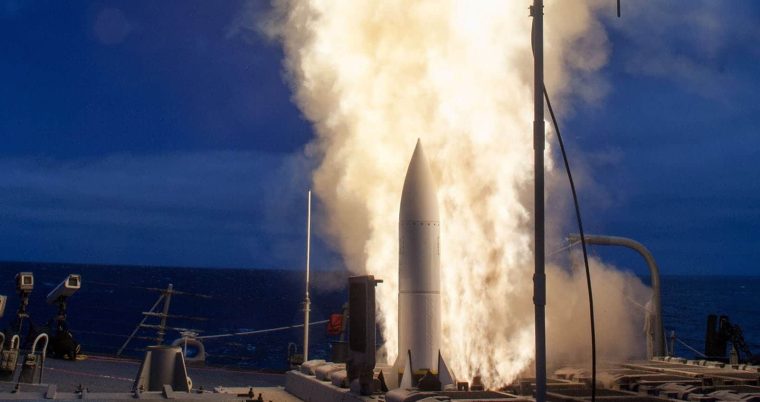
The Pentagon has awarded Raytheon, an RTX business, a contract worth up to US$24.4bn to produce Standard Missile-6 (SM-6) weapons for the US Navy. The missile provides anti-air, anti-surface and ballistic missile defence capabilities.
A second contract, valued at up to US$6.3bn, covers production and sustainment of Standard Missile-3 Block IB (SM-3 IB) interceptors, used against ballistic missiles.
Both agreements cover five years, with options for a further two. They follow framework agreements announced in February 2026 under Washington’s Arsenal of Freedom initiative, aimed at increasing weapons production through longer-term contracts.
Michael P. Duffey, Under Secretary of War for Acquisition and Sustainment, said:
“This multi-year award locks in the magazine depth and lethal dominance our forces need to prevail, while demanding our industrial base produce at war-speed.”
RTX is targeting annual SM-6 production of more than 500 missiles. The company has already invested in its manufacturing facilities, but further expansion will depend on specialist suppliers, particularly those producing guidance systems and propulsion components.
The full contract values are subject to future funding decisions. While the agreements provide greater certainty for manufacturers, the timing of further investment and production increases will depend partly on congressional appropriations.
BAE Systems Targets Higher APKWS Production
BAE Systems has reached a framework agreement with the Pentagon covering procurement of up to 25,000 Advanced Precision Kill Weapon System (APKWS) guidance kits annually for as long as seven years. Manufacturing capacity could rise to 35,000 kits a year to meet allied demand.
APKWS converts unguided 70mm rockets into precision-guided weapons, offering a less expensive way to counter drones than some conventional air-to-air missiles. This makes it particularly relevant as armed forces seek affordable defences against large numbers of low-cost drones.
BAE Systems already has manufacturing capacity for at least 25,000 kits annually. The agreement provides greater certainty over future demand, supporting investment in long-lead components, facilities and skilled workers.
The Pentagon and BAE Systems must still negotiate the final multi-year procurement contract, subject to congressional authorisation and funding. Further expansion would depend on allied requests through the US Foreign Military Sales programme.
Pentagon Tests New Counter-Drone Defences
The Pentagon has selected four directed-energy systems for operational testing as it looks for alternatives to conventional missile interceptors against low-cost drones.
The systems, chosen for the Joint Interagency Task Force 401 (JIATF-401) pilot programme, are:
- AeroVironment: Palletized High-Energy Laser
- Epirus: Leonidas High-Powered Microwave
- Kord: Firefly High-Energy Laser
- Boeing: Compact Laser Weapon System
The trials will assess how lasers and high-powered microwaves perform at US military installations, including power requirements, reliability, integration with existing defences and maintenance costs.
JIATF-401 is also preparing a demonstration in December 2026 to assess additional directed-energy systems, with the results potentially informing future procurement decisions.
Conventional counter-drone systems are already attracting substantial orders. On 13 October 2026, Raytheon announced US$729m in contracts to supply components of its Low, Slow, Small Unmanned Aircraft Integrated Defeat System (LIDS) to the US Army, Qatar and Jordan.
The contracts include Ku-band Radio Frequency Sensor (KuRFS) radar and Coyote interceptors, marking their first international sales. The system combines threat detection with kinetic and non-kinetic effectors to counter individual drones and swarms.
The Pentagon is also seeking to speed up counter-drone deployment. An October 2026 memorandum, Accelerating Employment of Counter-Unmanned Aircraft Systems to Protect American Airspace Sovereignty, directs officials to use existing test evidence, consider conditional approvals and justify decisions to reject deployment requests.
Together, the orders, trials and policy changes show growing demand for counter-drone systems that can be deployed in sufficient numbers and at a sustainable cost. For emerging directed-energy technologies, operational testing will determine which warrant further development or procurement.
Market Outlook
The Pentagon’s longer-term contracts give missile manufacturers greater confidence to invest, although new production capacity will take time to bring online.
Allied orders could support further expansion, but overseas customers may face longer delivery times while US inventories are replenished.
Competition is also changing. Anduril’s new Steelfin interceptor family uses common components across different missile variants to simplify production, with flight testing planned for 2027. The company is also considering European manufacturing partnerships as governments seek to strengthen domestic air defence capabilities.
These developments could open opportunities for newer suppliers alongside established defence contractors. However, securing orders will depend on successful testing, manufacturing readiness and the ability to meet customer requirements at a competitive cost.
Visiongain Insight
The Pentagon is investing in more than additional missile stocks. Its latest agreements and counter-drone trials point to greater emphasis on weapons that can be manufactured and replenished in sufficient numbers to meet sustained operational demand.
Advanced interceptors will remain essential against sophisticated threats. But cheaper drones require a different balance between performance, cost and availability.
The opportunity for suppliers extends beyond the finished weapon to the components, manufacturing capabilities and integration expertise needed to sustain production. Assessing that opportunity requires a clear view of funded demand, supplier bottlenecks and procurement timelines.
From Visiongain:
Visiongain Primary Research
Visiongain is conducting an independent study into US drone manufacturing capability and requirements, commissioned by Manufacturing Technology Deployment Group (MTDG). Confidential interviews with industry participants examine production capacity, component availability, and trusted supply chains. Learn about the study and how to participate.
Drones & UAV Intelligence Hub
Visiongain’s Drones & UAV Intelligence Hub brings together market forecasts and competitive intelligence covering drone manufacturing, counter-UAV technologies, defence procurement and supply chains.
Visiongain’s forthcoming Counter-UAV market report will examine the technologies, suppliers and procurement trends shaping the market. Contact Visiongain to request advance sample pages.
Related research:
- Small Drones Market Report 2026-2036
- Drone Service Market Report 2026-2036
- Military Identification Friend or Foe Market Report 2026-2036
Press & Media Enquiries
For commentary, data requests or interview enquiries, please contact: press@visiongain.com