Mothership / Launch & Recovery Support Systems Market to Reach US$4.76bn by 2036
4 June 2026.
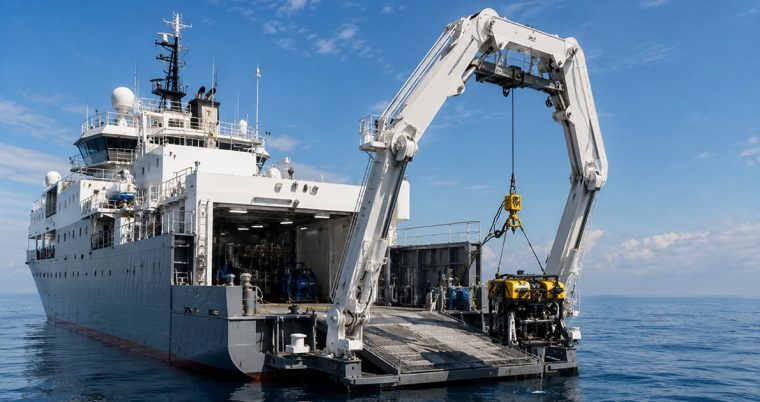
Growing deployment of UUVs, USVs, and autonomous seabed systems is creating unprecedented demand for launch, recovery, mission support, and mothership technologies. Visiongain’s in-depth report examines the global Mothership / Launch & Recovery Support Systems Market Report 2026-2036, providing detailed forecasts and strategic analysis across defence, commercial, and public safety, technology trends, trade impacts, and leading companies.
The future of maritime operations is increasingly autonomous.
As governments and naval forces expand the deployment of autonomous underwater and surface platforms, attention is shifting beyond the vehicles themselves toward the infrastructure required to operate them effectively. Launch and recovery systems, autonomous mission support architectures, dedicated support vessels, and mothership platforms are rapidly emerging as critical components of modern maritime operations.
Download Free Sample Report (incl. forecasts, market data, and methodology):
According to Visiongain’s latest market analysis, the Global Mothership / Launch & Recovery Support Systems Market is projected to grow from US$2.51 billion in 2026 to US$4.76 billion by 2036, representing a compound annual growth rate (CAGR) of 6.6% during the forecast period.
The market is being driven by rising demand for autonomous maritime operations, increasing investment in undersea surveillance missions, growing emphasis on critical infrastructure protection, and the development of distributed naval warfare concepts.
As autonomous systems become increasingly central to maritime defence strategies, support platforms are becoming indispensable force multipliers.
The Rise of the Autonomous Mothership
One of the most important trends shaping the future of maritime operations is the emergence of the autonomous mothership concept. Historically, naval vessels performed support functions as secondary roles. Future maritime architectures increasingly envision dedicated support platforms specifically designed to deploy, sustain, coordinate, and recover autonomous assets.
These motherships may function as:
- UUV deployment hubs
- USV operational centres
- Mobile command-and-control nodes
- Logistics and maintenance platforms
- Autonomous mission coordination centres
By serving as operational hubs for autonomous fleets, motherships significantly expand mission endurance and operational reach. As naval forces continue pursuing distributed maritime operations, demand for specialised support platforms is expected to increase substantially.
Technology and Innovation
Technological innovation is playing a pivotal role in the evolution of the global mothership and launch & recovery support systems market. Advances in autonomous navigation, artificial intelligence, sensor fusion, and automated handling equipment are enhancing the efficiency and reliability of deploying and recovering unmanned aerial, surface, and underwater vehicles. Modern support systems are increasingly designed to operate in challenging sea states while minimizing crew involvement, improving operational safety and mission success rates. Additionally, the integration of digital twins, predictive maintenance technologies, and modular platform architectures is enabling operators to optimize fleet readiness, reduce lifecycle costs, and adapt support vessels to a broader range of mission requirements.
Trade and Supply Chain Considerations
Impact of U.S. Trade Tariffs on the Global Mothership / Launch & Recovery Support Systems Market
U.S. trade tariffs and broader geopolitical trade restrictions have introduced new challenges for the global mothership and launch & recovery support systems market. Tariffs on imported electronic components, specialized marine equipment, steel, aluminum, and advanced manufacturing inputs have increased production costs for vessel builders and system integrators. In response, manufacturers are diversifying supplier networks, pursuing regional sourcing strategies, and investing in domestic production capabilities to reduce dependency on tariff-affected imports. While these measures improve supply chain resilience, they can also increase capital expenditure and extend project timelines. As defense and maritime operators prioritize secure and reliable supply chains, procurement decisions are increasingly influenced by trade policies, localization requirements, and strategic industrial partnerships.
Market Opportunities
Growing Adoption of Autonomous and Unmanned Maritime Systems
The rapid adoption of unmanned aerial vehicles (UAVs), unmanned surface vehicles (USVs), and autonomous underwater vehicles (AUVs) presents a significant growth opportunity for the global mothership and launch & recovery support systems market. Defense forces, offshore energy operators, and maritime security agencies are increasingly deploying autonomous platforms for surveillance, reconnaissance, mine countermeasures, environmental monitoring, and infrastructure inspection. As the number and complexity of unmanned systems increase, demand is rising for advanced motherships capable of safely deploying, controlling, and recovering multiple autonomous assets during extended missions. Manufacturers that develop scalable, automated, and multi-platform launch and recovery solutions are well positioned to benefit from this expanding operational requirement.
Expansion of Offshore Energy and Maritime Infrastructure Activities
The continued expansion of offshore energy projects, including offshore wind farms, deepwater oil and gas developments, and subsea infrastructure networks, is creating new opportunities for mothership and launch & recovery support system providers. Operators increasingly rely on remotely operated and autonomous systems to inspect, maintain, and monitor critical offshore assets while reducing operational costs and personnel exposure to hazardous environments. Specialized support vessels equipped with advanced launch and recovery technologies enable efficient deployment of drones and underwater vehicles in challenging offshore conditions. As governments and private investors continue to invest in offshore infrastructure and renewable energy projects worldwide, demand for reliable support platforms is expected to increase, supporting long-term market growth.
Competitive Landscape
The global Mothership / Launch & Recovery Support Systems market includes naval shipbuilders, mission systems integrators, autonomous technology developers, launch and recovery specialists, and maritime support platform manufacturers.
Leading participants include: Anduril Industries, ASELSAN, Atlas Elektronik, BAE Systems Plc, Ultra Maritime, Curtiss-Wright, Elbit Systems, Exail Technologies, FINCANTIERI S.p.A., General Dynamics, Hanwha Group, Huntington Ingalls Industries, Israel Aerospace Industries, Kraken Robotics, Kongsberg Gruppen, L3Harris Technologies, Leonardo S.p.A., Lockheed Martin, Naval Group, Oceaneering International, Inc., RTX Corporation, Saab AB, Teledyne Technologies, Thales Group, ThyssenKrupp Marine Systems (TKMS)
Competition is increasingly focused on autonomous deployment technologies, mission support capabilities, launch and recovery performance, vessel integration expertise, modular deployment architectures, and AI-enabled operational management systems.
Recent Developments
- March 18, 2026: Description: Academic and defense research teams finalized a highly efficient, autonomous airborne recovery framework utilizing a fixed-wing UAV acting as a “mothership” for mid-air quadrotor deployment and recovery. Utilizing vision-based relative pose alignment via specialized ArUco marker arrays combined with an actively actuated V-shaped mechanical docking plate on the mothership, this system mitigates wind-shear and residual misalignment. This advancement significantly expands the operational endurance and range of multi-UAV swarms for tactical defense and surveillance missions.
- March 19, 2026: MacArtney Offshore Solutions announced the successful rollout and shipment of its first fully electric eLARS (electric Launch and Recovery System) No. 1 from its Bur facility in Denmark to Allseas in Rotterdam. Built as an eco-friendly and quiet alternative to heavy hydraulic units, the shipment included both an advanced electric A-frame and an electric winch system designed for heavy Remotely Operated Vehicle (ROV) handling. A second complete system was shipped to Allseas shortly after on April 21, 2026.
- May 28, 2026: Raken Robotics successfully demonstrated its KATFISH towed synthetic aperture sonar and autonomous launch and recovery system (LARS) integrated on SEFINE’s RD-22 Unmanned Surface Vessel (USV) acting as a surface mothership. The system live-streamed 3cm x 3cm high-resolution data back to shore for rapid mine-like object detection. Following the trials, Kraken signed a Memorandum of Understanding (MOU) with SEFINE SISAM to fully integrate the autonomous LARS and sonar directly into their automated seabed warfare and mine countermeasure mission software.
- May 14, 2026: James Fisher Defence (JFD) announced the successful completion of the “RESCUEX East 2026” exercise on behalf of the UK, France, and Norway. The high-stakes operation proved the end-to-end mobilization capability of the NATO Submarine Rescue System. The exercise involved transporting, road-shipping, and embarking deep-sea rescue vehicle launch and recovery equipment onto a Norwegian vessel of opportunity, executing a successful deep certification dive to over 600 meters, and deploying a functional Transfer Under Pressure (TUP) system for rescued personnel.
Download Free Sample Report (incl. forecasts, market data, and methodology):
About Visiongain
Established in 1998, Visiongain is an independent publisher of analyst-led market intelligence, delivering data-driven research, forecasts, and strategic insight across global industries and emerging markets. Visiongain supports evidence-based decision-making for investment, procurement, and long-term strategic planning.
Media Contact
press@visiongain.com
+44 (0)20 7336 6100
www.visiongain.com