Military Communications & COTS Market to Reach US$75.7bn
21 July 2026.
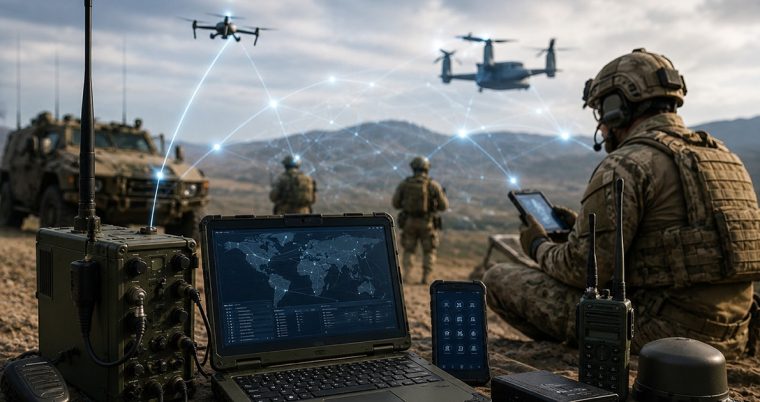
Visiongain’s latest report, Military Communications & COTS Market Report 2026-2036, provides detailed forecasts and strategic analysis across core network platform, communication network type, network management and operations, and voice and communications technology segments, including technology trends, trade and supply chain dynamics, and competitive positioning.
The global military communications and COTS market is valued at US$42.90 billion in 2026 and is projected to reach US$75.70 billion by 2036, at a CAGR of 5.8% during the forecast period. Growth is driven by the accelerating adoption of multi-domain operations and JADC2 frameworks, rising investment in software-defined radios and encrypted tactical communications, and the expanding integration of COTS technologies into military communication architectures to improve interoperability and reduce procurement timelines.
Key Market Insights
- The global military communications and COTS market will reach US$75.70 billion by 2036, growing at a CAGR of 5.8%
- Growth is driven by multi-domain operations, JADC2 investment, satellite communications expansion, and accelerating COTS adoption across defence communication programmes
- Key regions: North America, Europe, Asia Pacific
- Leading companies: L3Harris Technologies, Thales Group, General Dynamics, Northrop Grumman, Rohde & Schwarz
- Key trend: Transition to open architecture and modular communication systems enabling faster integration of COTS technologies and reducing lifecycle costs across military platforms
Market Drivers
Accelerating Multi-Domain Operations and JADC2 Initiatives
The growing adoption of multi-domain operations is one of the strongest drivers of the global military communications and COTS market. Modern armed forces require the seamless exchange of intelligence and operational data across land, air, sea, space, and cyber domains in real time, driving investment in resilient communication networks capable of connecting sensors, command centres, combat platforms, and autonomous systems through secure and interoperable architectures.
The U.S. Department of Defense’s JADC2 initiative seeks to establish a unified communications ecosystem linking every military service through cloud-enabled networks, tactical data links, satellite communications, and AI-supported decision systems. Similar modernisation efforts are underway across NATO member states and Indo-Pacific allies, where integrated communications are viewed as essential for coalition interoperability and faster battlefield decision-making. COTS technologies have become instrumental in enabling this shift, providing scalable computing, networking, and software capabilities that can be integrated more rapidly than traditional bespoke military hardware.
Rising Investment in Software-Defined Radios and Secure Tactical Communications
The modernisation of tactical communications is driving substantial investment in software-defined radios, secure networking equipment, and encrypted communication systems. SDRs support multiple frequencies, waveforms, and communication standards through software updates rather than hardware replacement, significantly extending equipment lifecycles while enabling rapid adaptation to evolving operational requirements and coalition interoperability standards.
Several NATO countries continue to expand deployment of advanced SDR platforms to improve interoperability during multinational operations, while India is investing heavily in indigenous tactical communication systems under defence modernisation initiatives aimed at reducing import dependence. Companies including L3Harris Technologies, Thales Group, Elbit Systems, and ASELSAN continue introducing upgraded SDR families capable of supporting high-bandwidth data, voice, and video communications across contested battlefield environments.
Technology & Innovation
Increasing Adoption of COTS Technologies for Faster Capability Deployment
Defence organisations are increasingly adopting COTS technologies to accelerate modernisation while controlling procurement costs. COTS-based solutions enable modular system architectures, simplify maintenance, shorten procurement timelines, and facilitate continuous software upgrades without replacing entire communication systems. This trend is particularly evident in ruggedised servers, edge computing platforms, IP networking equipment, embedded processors, and virtualisation technologies used across military communication networks.
Programmes following the U.S. Department of Defense’s Modular Open Systems Approach increasingly specify open standards enabling integration of commercial technologies from multiple suppliers, reducing vendor lock-in while improving long-term scalability. In February 2026, Northrop Grumman introduced Valen, a next-generation AESA system integrating radar, electronic warfare, and communication capabilities with open architecture support for secure, high-performance communication across air and space platforms.
Trade & Supply Chain Dynamics
U.S. tariffs on electronic components, semiconductors, communication hardware, and network equipment are directly influencing procurement costs and supply chain stability across the global military communications and COTS market. Tactical radios, SATCOM terminals, and IP-based network infrastructure depend on globally sourced components, making them vulnerable to trade restrictions and pricing fluctuations.
Tariffs have led to increased costs for imported communication components, forcing defence contractors to reassess sourcing strategies and shift toward alternative suppliers or domestic manufacturing. While short-term pressures may slow procurement cycles and delay certain programmes, they are also driving adoption of modular and open architecture communication systems that allow easier integration of alternative COTS components without significant redesign.
Commercial Impact
- Cost pressure: Tariffs on electronic components, semiconductors, and communication hardware are increasing procurement costs across tactical, strategic, and SATCOM programmes, affecting both prime contractors and supply chain partners
- Supply chain shifts: Defence contractors are diversifying sourcing, qualifying alternative suppliers, and accelerating domestic manufacturing investment to reduce dependency on tariff-affected regions
- Architecture adaptation: Tariff dynamics are pushing defence organisations to adopt modular, open architecture communication systems enabling integration of alternative COTS components without significant redesign
- Competitive positioning: Companies with diversified supply networks and domestic manufacturing capabilities are better positioned to maintain delivery commitments and manage cost volatility
Market Opportunities
Communication Modernisation Across Emerging Defence Markets
A significant growth opportunity lies in modernisation programmes being undertaken by emerging defence economies. While North America and Western Europe possess relatively mature military communication infrastructures, countries across Asia Pacific, the Middle East, Eastern Europe, Latin America, and Africa are replacing aging analog and proprietary systems with digital, IP-enabled networks covering tactical radios, battlefield management systems, secure communication networks, and mobile command centres.
India’s defence indigenisation programme, Poland’s large-scale military modernisation, and increasing investment by GCC countries illustrate the expanding addressable market for communication solution providers. Many governments are also prioritising indigenous manufacturing and technology transfer, creating opportunities for international defence communication companies to establish local partnerships and licensed production arrangements with suppliers offering scalable and interoperable COTS-enabled solutions.
Expansion of Unmanned and Autonomous Military Platforms
The rapid deployment of UAVs, unmanned ground vehicles, unmanned surface vessels, and autonomous underwater vehicles presents a substantial growth opportunity for military communication providers. Autonomous systems rely almost entirely on secure, high-bandwidth, and low-latency communication links for command, control, intelligence sharing, and collaborative operations. As militaries deploy swarms of autonomous platforms across multiple domains simultaneously, demand is rising for communication networks supporting machine-to-machine connectivity and resilient beyond-line-of-sight communications.
Recent conflicts have demonstrated the operational value of unmanned systems for reconnaissance, surveillance, logistics, and precision strike, encouraging governments to accelerate autonomous defence investment. Communication companies providing secure networking, resilient data links, edge computing integration, and autonomous communication management are expected to benefit significantly as unmanned military operations continue to expand globally.
Competitive Landscape
The major players operating in the military communications and COTS market include Airbus, ASELSAN, BAE Systems, Bharat Electronics (BEL), Curtiss-Wright, Elbit Systems, Frequentis, General Dynamics, HENSOLDT, Honeywell, Hytera Communications, Indra Sistemas, Iridium Communications, Israel Aerospace Industries, Kongsberg Gruppen, L3Harris Technologies, Leonardo, Motorola Solutions, Northrop Grumman, Rheinmetall, Rohde & Schwarz, RTX Corporation, Saab AB, Thales Group, and Viasat.
These companies are strengthening their market positions through M&A, R&D investment, strategic collaborations, and new product launches, with increasing focus on SDR platform upgrades, SATCOM capability expansion, and open architecture communication systems for multi-domain operations.
Recent Developments
- March 2026 – BAE Systems introduced Silver Link, a new portfolio of conformal antenna aperture solutions for air dominance programmes, offering modular, cost-effective designs that support rapid transition from prototype to full fleet integration across airborne-assured communication applications
- February 2026 – Thales Alenia Space partnered with Hellas Sat, CNES, and Safran to develop next-generation optical communication systems for the Hellas Sat 5 satellite, enabling ultra-high-speed, secure data transmission using laser communication technology
- February 2026 – L3Harris received a full-rate production contract from General Dynamics Electric Boat to deliver 26 shipsets of advanced communication systems for Virginia- and Columbia-class submarines, with production planned through 2033 and potential expansion to allied navies
- February 2026 – Northrop Grumman introduced Valen, a next-generation AESA system integrating radar, electronic warfare, and communication capabilities with open architecture support for secure, high-performance communication across air and space platforms
- July 2025 – General Dynamics successfully demonstrated its PhantomLink free space optics capability, achieving a 52-km link with data rates up to 10 Gbps, enabling secure, high-bandwidth communication with immunity to RF interference for contested battlefield environments
Frequently Asked Questions
What is driving growth in the military communications and COTS market?
Growth is driven by the accelerating adoption of multi-domain operations and JADC2 frameworks, rising investment in software-defined radios and encrypted tactical communications, and the expanding integration of COTS technologies into military communication architectures to improve interoperability and reduce procurement timelines.
How are trade and supply chain dynamics affecting the market?
U.S. tariffs on electronic components, semiconductors, and communication hardware are increasing procurement costs and disrupting globally integrated supply chains. This is accelerating supply chain diversification, domestic manufacturing investment, and the adoption of modular, open architecture systems that reduce dependency on single-source COTS components.
Who are the leading companies in the market?
Key players include L3Harris Technologies, Thales Group, General Dynamics, Northrop Grumman, Rohde & Schwarz, Leonardo, and BAE Systems.
Related Reports
Military Artificial Intelligence (AI) Systems Market Report 2026-2036
Military Radar System Market Report 2025-2035
Quantum Communication Market Report 2024-2034
About Visiongain
Established in 1998, Visiongain is an independent publisher of analyst-led market intelligence, delivering data-driven research, forecasts, and strategic insight across global industries and emerging markets. Visiongain supports evidence-based decision-making for investment, procurement, and long-term strategic planning.
Media Contact
press@visiongain.com
+44 (0)20 7336 6100
www.visiongain.com