Undersea Defence Intelligence Market to Reach US$58.6bn
9 June 2026.
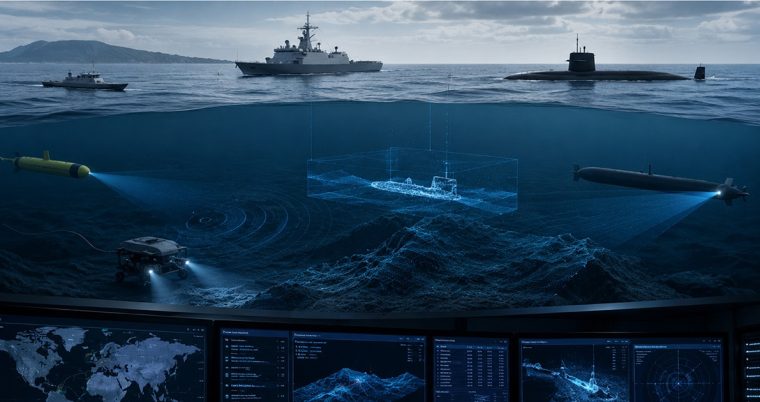
The underwater domain is rapidly becoming one of the most strategically significant areas of modern defence operations. As geopolitical competition intensifies and concerns over the security of critical seabed infrastructure continue to rise, governments worldwide are increasing investments in advanced undersea intelligence systems designed to improve maritime situational awareness, surveillance, reconnaissance, and threat detection capabilities.
According to Visiongain’s latest analysis, the global Undersea Defence Intelligence market is projected to grow from US$28.17 billion in 2026 to US$58.64 billion by 2036, representing a robust 7.6% CAGR during the forecast period.
The market’s expansion reflects a growing recognition among military planners and security agencies that underwater environments have become critical operational theatres. Undersea intelligence capabilities are increasingly viewed as essential for protecting strategic infrastructure, supporting naval operations, countering emerging threats, and maintaining maritime dominance in contested regions.
Download Free Sample Report (incl. forecasts, market data, and methodology)
Structural Shift toward Distributed Maritime Operations (DMO) and Fleet Decentralisation
Modern naval conflict patterns are driving an architectural transition away from an over-reliance on a small number of hyper-expensive, concentrated manned surface flagships. Because legacy destroyers, cruisers, and carrier strike groups face significant tracking overextension risks and acute vulnerabilities to low-cost asymmetric drone swarms, global naval commands are aggressively prioritizing the deployment of uncrewed intelligence platforms.
These autonomous systems function as low-cost, highly distributed sensor networks that extend the radar, passive electronic warfare, and anti-submarine warfare (ASW) screening perimeters of the fleet. Spacing out countless uncrewed hulls across massive oceanic sectors allows maritime forces to maintain persistent theater surveillance and force multi-tier interception dilemmas onto adversaries without exposing high-value crewed hulls or friendly personnel to front-line risks.
Immediate Imperative to Fortify and Secure Sub-Surface Critical National Infrastructure (CNI)
Escalating grey-zone activities, state-backed cutting events, and sabotage operations targeting trans-oceanic fiber-optic data channels and subsea energy pipeline trunks have fundamentally rewritten international naval procurement templates. Securing thousands of miles of deepwater conduits can no longer be handled effectively by periodic or reactive manned surface vessel patrols.
Consequently, navies are rapidly accelerating funding for long-endurance uncrewed vehicles and fixed seafloor sensor networks equipped with advanced variable-depth sonars and towed acoustic listening arrays. These systems maintain continuous station directly above vital subsea choke points, monitoring for anomalous sub-surface movements and providing an immediate, permanent defensive presence that reduces the operational strain on overstretched frontline fleets.
Technology and Innovation
Edge-Computed Autonomy, Advanced Sonar ATR, and Multi-Domain Data Fusion
The defining technological milestone expanding the global undersea intelligence landscape is the integration of advanced edge-computed artificial intelligence capable of processing massive data volumes locally on the ocean floor. Historically restricted by severe attenuation and low bandwidth water physics, next-generation systems no longer rely on surface-tethered manual umbilical links or slow raw data transmissions.
Equipped with high-definition Synthetic Aperture Sonars (SAS) and automated target recognition (ATR) software, modern uncrewed platforms cross-reference acoustic returns against pre-loaded target signature databases instantly at the edge. By identifying and classifying contacts locally and only transmitting condensed threat telemetry packets via hybrid acoustic-optical modems to satellite-connected surface relays, these innovations compress the tactical sensor-to-shooter loop from hours to seconds.
Trade and Supply Chain Considerations
Impact of U.S. Trade Tariffs on the Global Undersea Defence Intelligence Market
The global industrial base for advanced sub-surface data routing, uncrewed hulls, and maritime sensor packages is experiencing significant friction due to strict U.S. trade tariffs and expanded protectionist defense procurement updates. The enforcement of broad tariff frameworks and strict Buy American Act provisions has specifically targeted foreign sourcing of specialized micro-electronics, specialized low-loss glass fiber matrices, high-capacity marine lithium-ion battery cell modules, and rare-earth magnets required for high-efficiency electric thrusters. These trade barriers have injected considerable component cost volatility for major Western defense primes, generating near-term delivery backlogs and extending deployment timelines across multi-year planning horizons.
Concurrently, these trade penalties are forcing a structural bifurcation within the allied industrial supply chain ecosystem. To eliminate dependency risks on foreign manufacturing facilities vulnerable to geopolitical export embargoes or cyber-tampering events, tier-1 defense contractors are rapidly reshaping their manufacturing footprints.
Sovereign acquisition mandates increasingly demand total geographic insulation of the design and assembly base, requiring 100% native software cleanroom coding, specialized acoustic crystal casting, and complete pressure-hull fabrication inside domestic borders. While these tariffs accelerate localized capital investments within allied nations, they create an intermediate capacity bottleneck, restricting the delivery velocity of tier-2 component manufacturers that rely on non-insulated international logistics loops.
Open-Architecture Modular Payloads and Standardized Containerized Mission Bays
The development of standardized, containerized payload architectures presents an expansive commercial growth opportunity for flexible shipbuilders, component developers, and systems integrators. Next-generation uncrewed surface and subsurface designs are rapidly shifting away from closed, proprietary software ecosystems toward open-architecture mission decks that accommodate standardized plug-and-play frames using universal communication protocols (such as JANUS).
This technological modularity enables naval forces to rapidly hot-swap hardware configurations based on immediate operational requirements—shifting from passive electronic warfare (EW) screening and hydroacoustic mapping to active mine countermeasures (MCM) or precision strike roles within a multi-hour turnaround. By decoupling specific payload suites from custom-built, dedicated military hulls, navies can compress development cycles and lower asset entry barriers by up to 65%.
Commercial Ship Conversions, Rapid Modular Refits, and Seafloor Resident Docks
The urgent demand to scale up undersea fleet numbers and persistent monitoring hours without waiting for multi-year shipyard hull construction timelines has unlocked an expansive market opportunity in commercial vessel modifications and persistent seafloor docking networks. Systems integrators are leveraging advanced modular autonomy bolt-on kits and automated launch-and-recovery systems (LARS) to rapidly refit standard commercial offshore patrol ships, tugs, or oil-and-gas support vessels into high-utility uncrewed motherships.
Concurrently, the integration of permanent bottom-mounted node frameworks that combine long-life inductive power charging pads with secure fiber connections allows uncrewed assets to remain submerged for months at a time. Passing vehicles can dock, recharge, and automatically dump collected data streams invisibly, optimizing capital expenditure allocations by allowing a small, low-cost network grid to monitor vast underwater corridors without requiring continuous surface ship support footprints.
Competitive Landscape
The competitive landscape is characterised by a mix of global defence contractors, maritime technology providers, autonomous systems developers, and specialised underwater intelligence companies.
Major industry participants include Anduril Industries, BAE Systems, General Dynamics, Lockheed Martin, L3Harris Technologies, Thales Group, Leonardo, Naval Group, Kongsberg Gruppen, Kraken Robotics, Teledyne Technologies, RTX Corporation, Saab, Exail Technologies, and Huntington Ingalls Industries, among others. Companies are increasingly focused on expanding autonomous capabilities, integrating artificial intelligence into intelligence architectures, and developing next-generation sensing and communications technologies to meet evolving defence requirements.
Recent Developments
- April 27, 2026: Huntington Ingalls Industries (HII) was awarded a high-stakes contract by the Defense Innovation Unit (DIU) to deliver a submarine Torpedo Tube Launch and Recovery (TTLR) system. The system allows U.S. Navy Virginia-class attack submarines to autonomously launch, dock, and retrieve REMUS 600/620 Unmanned Underwater Vehicles (UUVs) directly through standard 21-inch torpedo tubes without requiring diver or swimmer-delivery vehicle assistance, vastly expanding covert sub-surface ISR capabilities.
- 23, 2026: the U.S. Naval Sea Systems Command (NAVSEA) awarded Lockheed Martin’s Rotary and Mission Systems division a potential five-year, US$ 479.9 Million cost-plus contract to provide engineering labor, tactical data fusion integration, and sustainment for the AN/SQQ-89A(V)15 Anti-Submarine Warfare (ASW) combat system. The scope includes active/passive sonar baseline maintenance and threat-detection software integration for both the U.S. Navy and allied Foreign Military Sales (FMS) partners, specifically Japan and Australia.
- February 18, 2026: the U.S. Navy awarded Ultra Maritime a primary technology development contract for the next-generation Acoustic Device Countermeasure (ADC) MK6. The program focuses on embedding advanced autonomous signaling capabilities into sub-surface expendable acoustic decoys. The devices are engineered to generate tailored acoustic signatures designed to confuse, divert, and defeat incoming, highly adaptive adversary torpedo threats targeting friendly surface capital ships and submarines.
- May 6, 2026: Turkish defense prime Aselsan officially presented its new generation of uncrewed naval systems at the SAHA 2026 Exhibition in Istanbul. This includes the introduction of the KILIÇ Autonomous Underwater Strike System family—highly portable, low-detectability subsurface uncrewed assets engineered for asymmetric covert operations and precision target engagement. The subsurface units are built to execute missions either as standalone nodes or within coordinated multi-vehicle swarm formations alongside surface USVs.
- January 13, 2026: German naval supplier Gabler established a dedicated Subsea Drives business unit and announced a high-tempo production partnership with technology developer FLANQ to bring two sub-surface deployed uncrewed systems to market. The 4.5-meter hulls, named Ranger (for long-endurance ISR) and Raider (for precision single-use kinetic strike), are engineered to deploy directly from standard submarine torpedo tubes at depths down to 300 meters, allowing stealthy intelligence collection in highly denied or contested littoral naval environments.
Download Free Sample Report (incl. forecasts, market data, and methodology)
About Visiongain
Established in 1998, Visiongain is an independent publisher of analyst-led market intelligence, delivering data-driven research, forecasts, and strategic insight across global industries and emerging markets. Visiongain supports evidence-based decision-making for investment, procurement, and long-term strategic planning.
Media Contact
press@visiongain.com
+44 (0)20 7336 6100
www.visiongain.com