Uncrewed Surface Vehicles (USV) Market to Reach US$9.76bn by 2036
4 June 2026.
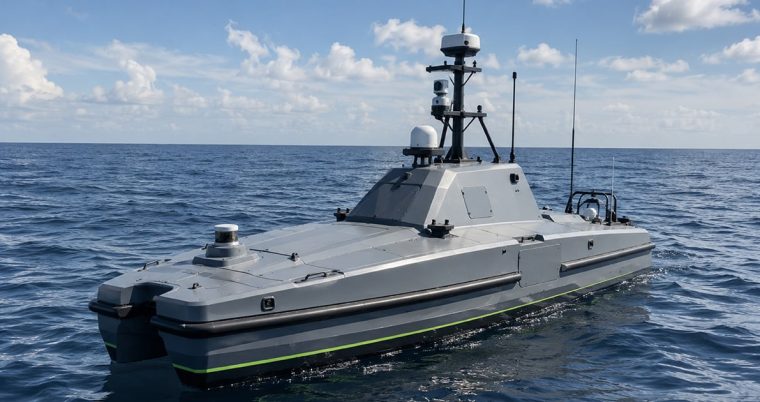
Growing demand for maritime surveillance, critical infrastructure protection, anti-submarine warfare support, and AI-enabled naval systems is accelerating adoption of autonomous surface vessels worldwide
The global maritime defence sector is undergoing a significant transformation as autonomous technologies become increasingly integrated into naval operations. Uncrewed Surface Vehicles (USVs) are emerging as one of the most strategically important categories within the broader autonomous maritime systems market, enabling military organisations to expand operational reach, improve maritime awareness, and conduct missions with reduced risk to personnel.
According to Visiongain’s latest analysis, the global Uncrewed Surface Vehicles (USV) Market is projected to grow from US$4.27 billion in 2026 to US$9.76 billion by 2036, achieving a robust compound annual growth rate (CAGR) of 8.6% during the forecast period.
The market is being driven by increasing naval modernisation programmes, growing geopolitical tensions across maritime regions, rising demand for persistent surveillance capabilities, and rapid advances in artificial intelligence, autonomous navigation, and maritime communications technologies.
As defence organisations seek cost-effective ways to strengthen maritime security and operational effectiveness, USVs are becoming a central component of future naval force structures.
Download Free Sample Report (incl. forecasts, market data, and methodology)
Transition to Distributed Maritime Operations (DMO) and Fleet Decentralisation
Modern naval warfare is undergoing a structural shift away from a small number of concentrated, multi-billion-dollar crewed surface flagships. Because legacy destroyers and cruisers face high tracking overextension risks and severe vulnerability to cheap anti-ship missile swarms, global naval commands are accelerating the deployment of Uncrewed Surface Vehicles (USVs). These autonomous surface platforms act as low-cost, highly distributed sensor nodes that extend the radar, electronic warfare, and anti-submarine screening boundaries of the fleet. By spacing out countless uncrewed hulls over massive oceanic zones, navies can maintain persistent theater surveillance and present multiple tactical intervention dilemmas to adversaries without risking high-value crewed hulls or personnel.
Immediate Imperative to Protect Sub-Surface Critical National Infrastructure (CNI)
Escalating grey-zone attacks and state-backed sabotage operations targeting trans-oceanic fiber-optic data networks and subsea energy pipelines have completely rewritten international maritime defense priorities. Securing thousands of miles of deepwater conduits can no longer be handled effectively by periodic manned vessel patrols. Navies are aggressively procuring long-endurance uncrewed surface hulls equipped with variable-depth sonars and towed acoustic listening arrays. These USVs maintain continuous station directly above vital subsea choke points, monitoring for anomalous sub-surface movements and providing an immediate, scalable defensive presence that reduces the workload on overstretched frontline fleets.
Technology and Innovation
COLREGs-Compliant Edge Autonomy and Cross-Domain Data Fusion
The defining technological milestone expanding the uncrewed surface market is the integration of advanced edge-computed artificial intelligence capable of strict compliance with International Regulations for Preventing Collisions at Sea (COLREGs). Utilizing multi-spectral sensor suites, including marine radar, LiDAR, and electro-optical AI camera networks, modern USVs automatically identify, track, and navigate around commercial shipping traffic in complex littoral corridors completely independent of a human operator.
Furthermore, these platforms function as high-utility cross-domain data routers; they pick up faint acoustic signals transmitted from autonomous underwater vehicles (UUVs) or deep seabed sonar nodes, process and compress the data streams locally at the edge, and beam the digitized telemetry data instantly via satellite arrays to regional cloud command centers.
Trade and Supply Chain Considerations
Impact of U.S. Trade Tariffs on the Global Uncrewed Surface Vehicles (USV) Market
The global industrial base for maritime autonomy is adjusting to major friction points generated by stringent U.S. trade tariffs and protectionist defense procurement updates. The enforcement of expanded tariff lines and strict Buy American Act mandates has specifically disrupted foreign sourcing of specialized micro-chips for autonomous navigation cards, military-grade composite hull materials, and advanced satellite transceiver sub-assemblies. These trade policies have significantly increased component volatility for Western defense primes, generating near-term delivery backlogs and extending initial hull integration timelines out past multi-year planning horizons.
Concurrently, these trade penalties are forcing a structural division within the defense-grade supply ecosystem. To guarantee line output during times of intense geopolitical tension, sovereign acquisition mandates are requiring total geographic insulation of the manufacturing base.
Contractors are rapidly relocating cleanrooms, shifting to domestic electronic component suppliers, and locking in long-term raw material lines for specialized hull resins within allied borders. While these tariffs accelerate localized capital investments, they present an intermediate capacity hurdle, limiting the output velocity of tier-2 subcomponent manufacturers that depend on non-insulated international logistics loops.
Modular Weapon Customisation and Containerised Mission Bays
The development of standardised, containerised payload architectures presents an expansive commercial opportunity for flexible shipbuilders and systems integrators. Next-generation USV designs utilize open-architecture mission decks that accommodate standardized plug-and-play frames.
This enables a single uncrewed vessel class to easily hot-swap hardware configurations based on immediate operational requirements—shifting from passive electronic warfare (EW) screening and hydroacoustic mapping to active mine countermeasures (MCM) or precision strike roles within a multi-hour turnaround. By decoupling specific payload suites from custom-built, dedicated military hulls, navies can compress development cycles and lower asset entry barriers by up to 65%.
Commercial Ship Conversions and Rapid Modular Refits
The urgent demand to scale up uncrewed fleet numbers without waiting for multi-year shipyard hull construction pipelines has unlocked a major market opportunity in commercial vessel modifications. Systems integrators are leveraging advanced modular autonomy bolt-on kits to rapidly refit standard commercial offshore patrol ships, tugs, or oil-and-gas support vessels into high-utility uncrewed motherships.
By installing automated launch-and-recovery systems (LARS) and independent navigation brains onto existing, readily available commercial hulls, maritime commands can field multi-domain uncrewed swarms at a fraction of standard defense acquisition timelines, providing immediate capital expenditure optimization across allied markets.
Competitive Landscape
The major players operating in the uncrewed surface vehicles (USV) market are Anduril Industries, ASELSAN, Atlas Elektronik, BAE Systems Plc, Curtiss-Wright, DSIT Solutions, Elbit Systems, Exail Technologies, FINCANTIERI S.p.A., General Dynamics, Hanwha Group, Huntington Ingalls Industries, Israel Aerospace Industries, Kraken Robotics, Kongsberg Gruppen, L3Harris Technologies, Leonardo S.p.A., Lockheed Martin, Naval Group, Oceaneering International, Inc., RTX Corporation, Saab AB, Teledyne Technologies, Thales Group, ThyssenKrupp Marine Systems (TKMS). These major players in this market have adopted various strategies, including M&A, collaborations, R&D investments, regional expansion, partnerships, and new product launches.
Recent Developments
- June 1, 2026: Huntington Ingalls Industries (HII) announced that its ROMULUS USV prototype has officially advanced to the U.S. Navy’s formal Medium Unmanned Surface Vessel (MUSV) at-sea testing phase. Prominently highlighted at the Combined Naval Event (CNE 2026), the ROMULUS platform focuses on integrating advanced autonomy into “ARMOR Force” structures, expanding fleet capacity for long-endurance oceanographic surveillance and distributed naval operations.
- May 27, 2026: San Diego-based autonomous maritime developer Seasats announced that its solar-powered Lightfish USV successfully completed the first autonomous transit of the Taiwan Strait. Controlled from hundreds of miles away, the small, long-endurance USV traversed over 1,000 nautical miles across five days. The vessel successfully logged and shared geolocated photographic evidence of heavy surface traffic, including encounters with Chinese People’s Liberation Army Navy (PLAN) warships.
- April 30, 2026: Textron Systems Corporation secured an Other Transaction Authority (OTA) contract from the Defense Innovation Unit (DIU) to manufacture and deliver a fleet of its TSUNAMI interceptor USVs. Built on Brunswick Corporation vessel platforms and utilizing Textron’s proprietary CUSV autonomy framework, these vessels will participate in the U.S. Navy Fourth Fleet’s Fleet Experimentation (FLEX) exercises in Key West, Florida, showcasing teamed intelligence, surveillance, and target acquisition.
- May 15, 2026: Collaborating with boat builder MetalCraft Marine, HII delivered its newest class of next-generation autonomous USV prototypes specifically configured for the U.S. Marine Corps. These highly agile, small-to-medium vessels are customized to fulfill expeditionary advanced base operations, allowing forward-deployed units to conduct remote reconnaissance and logistics support in shallow littoral zones.
- April 13, 2026: Textron Systems introduced its Multi-Mission Uncrewed Surface Vessel (MMUSV), representing the 5th generation evolution of its signature Common Unmanned Surface Vehicle (CUSV) craft. The new system scales up payload capacity to 13,000 pounds and doubles total fuel range. It is ruggedized to tow up to 4,000 pounds while surviving up to Sea State 5, providing an immediately mass-producible option for all-weather surface warfare, mine countermeasures, and electronic signals intelligence.
Download Free Sample Report (incl. forecasts, market data, and methodology)
About Visiongain
Established in 1998, Visiongain is an independent publisher of analyst-led market intelligence, delivering data-driven research, forecasts, and strategic insight across global industries and emerging markets. Visiongain supports evidence-based decision-making for investment, procurement, and long-term strategic planning.
Media Contact
press@visiongain.com
+44 (0)20 7336 6100
www.visiongain.com