Global Defence: Drones, Interceptors and Stockpiles
27 March 2026.
Sustained operations are exposing a gap between demand and available defence capacity. Magazine depth is more limited than previously understood, with replenishment timelines extending.
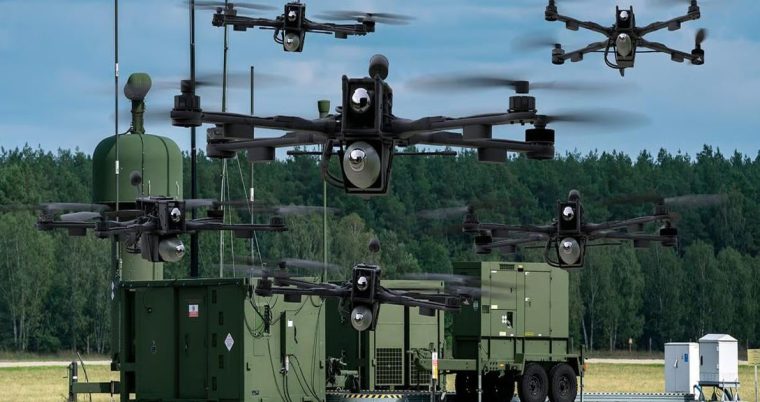
While missile exchanges dominate headlines, the volume of drone and loitering munition activity is placing equal, if not greater, pressure on stockpiles, interception systems and industrial output. The scale, precision and dispersed nature of these attacks are increasing the burden on existing defence architectures.
This article examines how these operational realities are reshaping procurement priorities, accelerating counter-UAS investment, and reinforcing the need for deeper, more resilient inventories across allied markets. If conflict moves to boots on the ground, demand for vehicle protection against FPV drones and improvised explosive threats is expected to rise.
Visiongain Top Takeaways
- Stockpile depth is more limited than expected, with replenishment timelines extending over multiple years.
- Counter-UAS demand is rising rapidly as drones and loitering munitions account for the majority of operational activity.
- Distributed and high-volume attack patterns are increasing pressure on interception systems and defence architectures.
- Air and missile defence systems are being tested not only for performance but also for sustained availability and reload capacity.
- Ground operations would further intensify demand for vehicle protection systems against FPV drones and improvised explosive threats.
Market Activity
United Kingdom: Strengthening Counter-UAS Support and Regional Engagement
Recent developments in the Middle East are driving increased UK defence engagement with Gulf partners, with a focus on rapid deployment of defensive capabilities. While missile exchanges dominate headlines, UAVs and one-way attack drones have accounted for the majority of operational activity, reinforcing the urgency of counter-UAS investment.
The UK Minister for Defence Readiness and Industry, Luke Pollard, and the National Armaments Director, Rupert Pearce, convened representatives from 13 UK-based defence companies alongside Gulf ambassadors and defence attachés. Participating countries included Saudi Arabia, Kuwait, Bahrain, Qatar, the UAE, Iraq and Jordan.
The meeting highlighted the urgency of supplying defensive systems at pace to regional partners. Attendees included a mix of established primes and newer technology providers, highlighting the changing structure of the counter-UAS market.
The UK Ministry of Defence has confirmed further procurement of Lightweight Multirole Missiles (LMM), manufactured by Thales in Belfast, to support both British forces and regional partners. Training support in the UK is also expected where required.
Operational performance is already shaping procurement interest. Systems such as Martlet (LMM), ORCUS, NINJA, Rapid Sentry and Stormer have demonstrated effectiveness in counter-UAS roles. The success of LMM in particular is likely to support further demand, including its integration with platforms such as the AW159 Wildcat.
Visiongain Insight: Procurement is shifting toward systems proven in live counter-UAS operations. Speed of deployment and demonstrated effectiveness are becoming key differentiators.
United States: Expanding THAAD Production and Securing Supply Chains
The United States is moving to address critical shortages in the Terminal High Altitude Area Defense (THAAD) system, which has become both a strategic and political issue, intensified by recent operational demands in the Middle East.
The Department of War (US Department of Defense), in partnership with BAE Systems and Lockheed Martin, has announced a framework agreement to quadruple production of THAAD interceptor seekers. This follows a separate initiative to increase overall interceptor production.
The agreement marks a shift toward rebuilding defence industrial capacity across the full supply chain rather than relying solely on prime contractors. By securing long-term production of critical components such as seekers, the aim is to increase output and improve delivery timelines.
The arrangement also provides stability for suppliers such as BAE Systems, supporting long-term investment in production capacity.
The announcement stated:
“This initiative is a powerful demonstration of the Department’s revitalized Acquisition Transformation Strategy, put into practice by the work of the Munitions Acceleration Council. The Council is executing its mandate to dismantle barriers, forge stronger industry partnerships, and build enduring production capacity. By locking in the THAAD seeker supply, the Department is transforming to a new way of doing business, focused on speed, volume, and delivering a decisive overmatch against any threat.”
Visiongain Insight: Missile defence is increasingly constrained by component supply rather than system design. Securing the production of critical subcomponents, such as seekers, will be central to scaling output.
Middle East: Cheongung II Strengthens Position in Air Defence Markets
South Korea’s Cheongung II (KM-SAM) air defence system is emerging as a leading export system following operational use in the region, where performance under live conditions has strengthened its market position.
Developed by LIG Nex1, Hanwha Systems and Hanwha Aerospace, the system is designed to intercept aircraft, cruise missiles and ballistic missiles. A typical battery consists of four launchers, a radar and a combat control centre.
The system has performed strongly for the United Arab Emirates, which received two batteries before the current conflict and is actively seeking to replenish its interceptor stocks. Saudi Arabia placed an order in 2024, with demand expected to see a step change as interest in cost-effective air defence systems increases.
Cheongung II is gaining traction due to its cost-effectiveness relative to competing systems. However, existing order backlogs are already extending delivery timelines, with production capacity emerging as a constraint.
Visiongain Insight: Export demand is shifting toward systems that combine proven performance with lower unit cost. Production capacity will determine how much of this demand converts into realised orders.
Market Outlook
Defence industrial capacity is emerging as a central constraint across allied markets.
Investment in production capability, including munitions, interceptors and counter-UAS systems, is now a long-term priority. At the same time, governments are accelerating spending to replenish stockpiles, placing increasing strain on defence budgets.
This tension is shaping near-term procurement strategy. Demand for counter-UAS and missile defence solutions continues to rise, while the ability to scale production and fund expansion remains constrained.
Political pressure to deliver capability at pace is intensifying, particularly as sustained operations draw down existing inventories. This is driving a greater focus on scalable production, supply chain resilience and rapid deployment capability.
Visiongain Insight: Production capacity, not technology, is becoming the primary constraint in defence markets. Suppliers able to scale output reliably will be best positioned to secure long-term contracts.
Related Visiongain Market Reports
Visiongain’s market reports provide the data and forecasting needed to assess funding priorities, capability development and execution risk across defence markets with confidence. Research is evidence-based and grounded in real-world market dynamics, supporting informed decision-making across procurement, industrial planning and strategy.
- Small Drones Market Report 2026-2036
- Undersea Defence Infrastructure & Security Market Report 2026-2036
- Autonomous Underwater Vehicle (AUV) Market Report 2026-2036
- Hypersonic Missile Defence Systems Market Report 2026-2036
- Military Simulation, Modelling and Virtual Training Market Report 2026-2036
- Advanced Materials in Aerospace and Defence Market Report 2026-2036
Press & Media Enquiries
For commentary, data requests or interview enquiries, please contact: press@visiongain.com