UDT 2026 Day Three: From Concept to Capability in Undersea Warfare
Visiongain Top Takeaways
Systems integration and situational awareness
Ana Belén Buendía, Head of Indra’s Naval Business Unit, stated: “our systems enable superior situational awareness and intelligence-gathering capabilities and prepare submarines to act as key assets in modern multidomain operations, while simultaneously enhancing their stealth and survivability.”
Indra also showcased its PEGASO Full Digital solutions, providing early warning, surveillance and detection capabilities to support survivability and the collection of ELINT and COMINT intelligence.
Training and simulation systems were also a focus, supporting crew preparation and mission rehearsal “with the highest level of realism,” reflecting growing demand for operational readiness in more complex and contested environments.
Visiongain estimates the global military simulation, modelling and virtual training market will grow from $18.81 billion in 2026 to $38.85 billion by 2036.
Maintenance and support services also featured prominently, aimed at maximising operational availability and extending platform lifecycles in line with NATO requirements. This reflects a wider shift towards increasing fleet effectiveness and operational impact, rather than expanding fleet size alone. Information advantage is becoming a core component of undersea capability.
Autonomy at scale: XLAUV and LUUV platforms
Autonomous systems remained central across the exhibition floor, with a clear shift towards larger, more capable platforms.
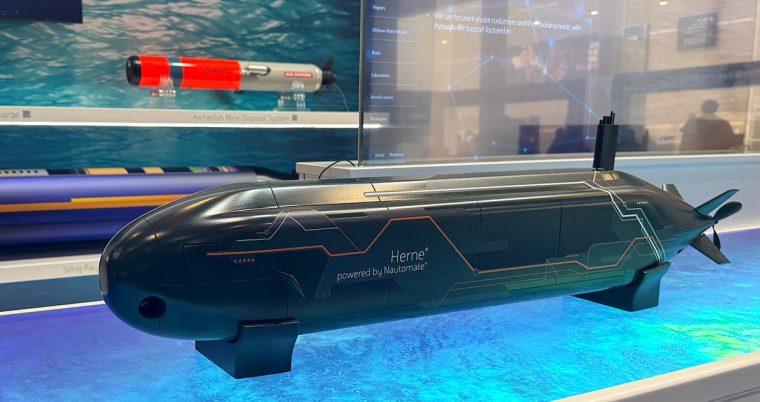
BAE Systems presented its Herne Extra Large Autonomous Underwater Vehicle (XLAUV), a modular, highly configurable platform designed to extend operational reach, reduce reliance on and risk to high-value crewed platforms and critical resources, and enable navies to cover more of the underwater battlespace.
Positioned at the leading edge of the battlespace, Herne provides a new military capability across mission types, including anti-submarine warfare, protection of critical infrastructure and ISR operations.
The platform integrates advances in battery, propulsion and autonomous control, reflecting a shift towards deployable, long-endurance systems.
At its core is BAE Systems’ Nautomate autonomous control system, with the vehicle expected to become the first XLAUV certified to the UMS Code and the first unmanned submersible classed under the SDS rules.
Lloyd’s Register is leading certification, providing “a robust and structured pathway to ensure the safety and reliability of large uncrewed submersibles.”
Key capabilities include rapid mission reconfiguration, low acoustic signature design, secure communications, flexible payload integration and advanced navigation systems. Its modular architecture supports payloads such as remotely operated vehicles, advanced sonar systems and range extension modules.
The platform also supports secure integration into wider digital battlespace networks, reflecting the growing importance of interoperability and data sharing in undersea operations.
In parallel, Saab showcased its Large Unmanned Underwater Vehicle (LUUV), developed under contract with the Swedish Defence Materiel Administration (FMV), with sea trials expected in summer 2026.
The platform is designed as a sensor-led system for monitoring seabed infrastructure and detecting underwater threats. Saab will integrate its Autonomous Ocean Core system, enabling advanced autonomy both on and below the surface.
The programme brings together Saab, the Swedish Armed Forces and FMV, reflecting a collaborative approach to advancing autonomous capability. The platform will not include weapon systems in its initial phase, focusing instead on sensing, monitoring and decision support.
Jesper Fahlén of FMV stated: “The craft will, among other things, have the ability to monitor large areas unmanned and autonomously.”
He added: “By working agile with the test operations, we explore the opportunities that technology provides.”
The programme will also inform future use of LUUV platforms launched and recovered from submarines, pointing to new operating concepts in undersea warfare.
While Herne reflects a move towards deployable, mission-ready capability, Saab’s LUUV programme highlights continued experimentation in how larger autonomous platforms will be integrated into future force structures.
Together, these developments point to a shift towards persistent, distributed undersea operations, where coverage and endurance are prioritised over platform concentration.
This is reflected in broader market growth. The global naval USV and UUV market is expected to grow at a CAGR of 10.2% between 2026 and 2036, accelerating further in the latter half of the decade, as autonomy moves into sustained demand.
Infrastructure protection and system-of-systems approaches
Fincantieri presented developments in both platform and infrastructure protection capabilities.
The U212 Near Future Submarine programme for the Italian Navy will include a mine-laying capability, with technical configuration expected to be finalised in 2026 ahead of deliveries from 2029.
Alongside this, Fincantieri showcased the DEEP system, a modular, scalable and cyber-secure “system of systems” designed to protect and monitor critical underwater infrastructure, as well as safeguard the marine environment.
The system has already been installed for demonstration at the Italian Navy’s Naval Support and Experimentation Centre (CSSN) in La Spezia, indicating a move towards operational deployment.
The system integrates:
Market implications: Visiongain Insight
For suppliers, this shifts the competitive landscape. Advantage will come from delivering interoperable systems, integrating rapidly across platforms and supporting long-term operational readiness, rather than from individual platforms alone.