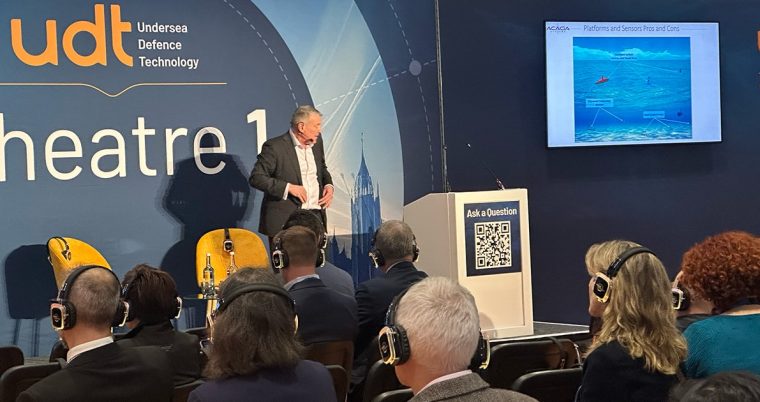
Day two at Undersea Defence Technology 2026 in London has brought maritime and undersea defence into clearer focus, as geopolitical developments continue to shape operational priorities and investment decisions. This update reflects key developments so far, with further analysis and full highlights to follow later today.
The ongoing Iran conflict is now being assessed not only in military terms, but also through its wider economic impact. Pierre-Olivier Gourinchas, Economic Counsellor at the International Monetary Fund, warned that the situation could trigger a global energy crisis on an unprecedented scale.
The IMF has indicated that even a near-term end to hostilities would still result in reduced global economic growth. Further escalation or damage to critical infrastructure would increase the likelihood of a broader recession. While political signals suggest the conflict may de-escalate, the medium and long-term implications for energy markets, trade and security are already taking shape.
The conflict has also shifted attention within the undersea technology market. Mining and demining, long-standing but often secondary concerns, have returned to the forefront as key operational challenges.
While the war in Ukraine accelerated development across unmanned systems and maritime warfare more broadly, the Iran conflict has highlighted the strategic importance of securing sea lanes against mine threats. Disruption in the Strait of Hormuz has reinforced the need for rapid mine clearance capabilities, often in contested and high-risk environments.
The conflict also reflects a broader pattern seen in Ukraine: adversaries adapting quickly and operating asymmetrically. The cost imbalance is clear. The resources required to secure maritime routes far exceed those needed to disrupt them.
Visiongain Insight: Mine warfare is re-emerging as a central constraint on maritime operations. The ability to deploy mines remains low-cost and scalable, while clearance is time-intensive and resource-heavy. This imbalance is likely to drive sustained investment in mine countermeasures, autonomous systems and rapid response capabilities across naval forces.
The focus on maritime disruption extends beyond shipping volumes. Subsea infrastructure is equally exposed.
Approximately 30% of intercontinental internet traffic passes through submarine cables in the Persian Gulf, the Strait of Hormuz and the Red Sea. These networks support critical functions, including banking systems, cloud infrastructure and government communications across Europe, Africa and Asia.
Visiongain analysis indicates that seventeen submarine cable systems pass through the Red Sea alone, carrying around 90% of data traffic between Asia and Europe. The current conflict marks the first time that both major maritime chokepoints, Hormuz and the Red Sea, have been simultaneously threatened.
This reinforces the need to protect both shipping routes and the subsea infrastructure that underpins global connectivity.
Visiongain Insight: The concentration of global data traffic through a limited number of subsea routes is creating a clear vulnerability. As threats to these corridors increase, investment is expected to expand beyond protection of shipping lanes to include monitoring, redundancy and rapid repair of subsea infrastructure. This will shape demand across surveillance, autonomy and subsea engineering capabilities.
These developments reinforce the growing importance of undersea defence technologies across multiple domains, from mine countermeasures to subsea monitoring and autonomous systems. In conversations on the exhibition floor today, procurement leads from three NATO-aligned navies indicated that mine countermeasure UUVs and subsea cable monitoring systems are now their highest-priority unclassified investment areas for 2027.
Visiongain Insight: The focus is shifting from awareness to resilience, with procurement increasingly centred on systems that can operate persistently and respond quickly in contested environments.
For detailed analysis of the markets addressing these challenges, follow Visiongain’s Market Watch ongoing UDT 2026 coverage, alongside post-event analysis, interviews, and in-depth reports:
For commentary, data requests or interview enquiries, please contact: press@visiongain.com